
New Research Focuses on How Industries and Activists Use Persuasion to Gain Public Support on Ballot Measures
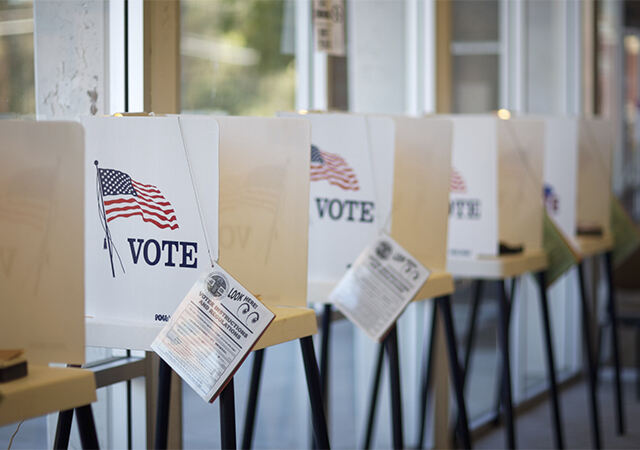
New research co-authored by University of San Diego marketing professor, Andrea Godfrey Flynn, outlines how industries and activists try to persuade the public to support their positions on prominent issues. Flynn, along with two researchers from Boston College, published a new article in the Journal of Marketing titled “How Industries Use Direct-to-Public Persuasion in Policy Conflicts: Asymmetries in Public Voting Responses.” The researchers examined the practice of direct-to-public persuasion, a key political influence strategy used to gain public support on contested issues when industry practices are opposed by activist groups.
The research is timely given the national attention generated by Proposition 22, a successful 2020 California ballot initiative, that gives gig economy ride hailing and delivery companies the legal right to treat drivers as independent contractors. The companies that sponsored Proposition 22 (including Uber, Lyft, and DoorDash) spent roughly $200 million on television and direct advertising campaigns (more than 10 times the spending of the groups opposing the industry-sponsored proposition). Analysts believe that industry advertising helped flip voter opinion to pass the proposition and give the industry a victory. Immediately after this success, industry leaders pledged to remake labor laws throughout the country.
“Our results indicate distinctive differences in how voters respond to the industry side’s arguments compared to how they respond to the activist side’s arguments,” said co-author Andrea Godfrey Flynn. “The differences are driven by voters’ evaluations of how strong and how suspicious each side’s arguments are and whether the arguments highlight financial or societal factors.”
The researchers developed a direct-to-public persuasion framework and tested their predictions with a field study that captured changes in the public’s attitudes and voting on two California ballot measures from the 2016 U.S. election. The first, Proposition 56, proposed a tobacco product tax increase and the second, Proposition 61, proposed new prescription drug price standards.
The tobacco and pharmaceutical industries battled healthcare activists for public support using persuasive arguments presented in expensive advertising (including television, direct mail, and social media) and PR campaigns. The researchers used three follow-up experiments to examine specific persuasion strategies used by the opposing sides.
Follow-up experiments show which argumentation strategies work best for each side. Financially-focused arguments (e.g., new price regulations will increase prescription drug costs for individuals) work best for the industry side while societally-focused arguments (e.g., prescription drug price regulations will provide better access to life-saving medicines) are more effective for the activist side, but the activist side gains more competitive advantage using societal arguments than the industry side does using financial arguments.
“Our findings offer practical guidance for marketers in future ballot initiatives, including those working with industry associations and public interest advocacy and activist groups, in terms of shaping their messages to be most effective in winning public support. Overall, industry groups may be most successful with a narrow, financially-focused argumentation strategy and raising skepticism of its opponents’ tactics, whereas activist groups may be better served by broader, societally-focused arguments with iron-clad strength,” added Flynn.