
Creating an Environment for Partnerships
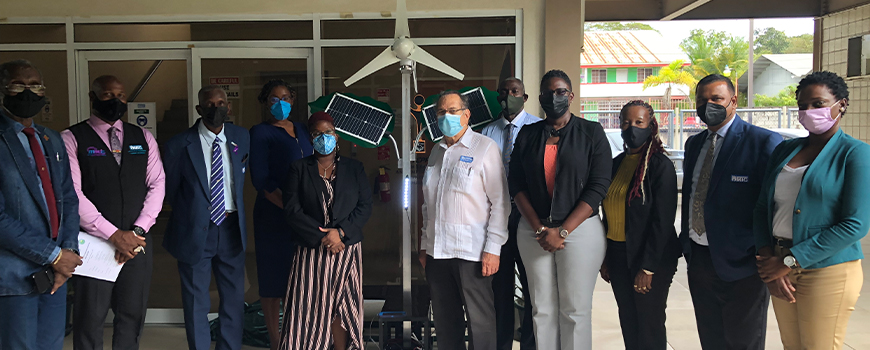
Odesma Dalrymple, PhD, wasn’t planning to discuss energy systems on a 2019 trip home to Trinidad and Tobago. However, the visit to the Caribbean nation resulted in a chance encounter with a family friend and a multi-year, micro-wind energy partnership.
“I had gone to my dad’s memorial service and his friend who worked as part of Tobago’s Division of Agriculture [was there],” says Dalrymple, an associate professor of industrial and systems engineering at the University of San Diego. “He said to me, ‘I’d really like to explore getting some alternative energy expertise here.”
Dalrymple agreed to look into it, but was unsure of next steps. Upon returning to USD, she was approached by a student looking for an independent study opportunity. That’s when it all clicked.
“I created an independent research study for this student to begin to explore the viability of wind energy for an agricultural context,” says Dalrymple. The Division of Agriculture official “was really looking at how we can use alternative forms of energy to support small farms.”
Dalrymple then reached out to Primo Energy, a hybrid wind and solar company, which agreed to be involved in the project.
She then turned to the Engineering Exchange for Social Justice (EXSJ), an initiative that was formed out of the Envisioning 2024 campus strategic plan, with the focus on supporting community projects through a collaborative partnership model.
With $2,000 in seed funding from the EXSJ, support from Associated Students through a research grant to support the student’s engagement, and Primo Energy’s commitment to provide an EnergiSeedling, Dalrymple had what she needed to move forward with the beginning stages of a micro-wind energy partnership.
Then the COVID-19 global pandemic hit, shutting down any plans for site visits to the Caribbean. However, even while the world was on lockdown, the partnership continued. Dalrymple connected with campus colleagues to discuss energy alternative opportunities and further developed a relationship with the MIC Institute of Technology (MIC-IT) in Tobago.
In January 2022, Dalrymple again returned to Trinidad and Tobago to see the unveiling of the multi-year partnership in the form of the EnergiSeedling, a dynamic, portable micro-wind system that makes renewable energy “visible and accessible.”
For Dalrymple, this is just the beginning, with plans to continue partnering with the MIC-IT to develop other alternative energy options manufactured in Tobago. From biogasoline to creating new wind and solar prototypes, Dalrymple sees USD as an integral part of the process.
“There is so much amazing expertise at USD. I see the Engineering Exchange for Social Justice functioning as an entity that brings other players and networks to the table,” she says. “Our role is to facilitate the partnership and when possible, support the development of the solutions with community partners through student, faculty and pro-bono professional engagement. We continue to nurture these relationships and create the infrastructure to bring together community needs with relevant sociotechnical expertise."
Going forward, Dalrymple is excited to see where the EXSJ and partnerships like this one connect the campus community with areas of need — whether that’s in our own backyard, or thousands of miles away.
— Allyson Meyer ’16 (BA), ’21 (MBA)