
Engineering Clean Water Access in Uganda
Think of precious resources needed to sustain life and think no further than clean water. While for the most part it is not difficult to find in the United States, access to clean water in other parts of the world is tougher to find and requires willing problem solvers.
Enter Ava Bellizzi and Christina Kozlovsky, Class of 2020 mechanical engineering graduates from USD’s Shiley-Marcos School of Engineering. For the past two years, they have worked to improve access to clean water in rural Uganda —— a country heavily impacted by poor water quality issues. They conducted research and testing on a filtration device that can ultimately help keep bacteria and toxic metals out of the water there and expand to other countries with similar issues.
“When you think of water quality being such a global problem, this was a huge challenge. Our thinking was ‘How do we put a dent in this problem?’” Bellizzi says.
“We created a device that removes contaminants and filters the water through at a reasonable rate, Kozlovsky says. When we were struggling with a solution, the thought of this device helping people — that it can make the world better — is something that will stay with me.”
The project, The Development of a Remediation Approach for the Removal of Bacteria and Toxic Metals for Use in Rural Uganda, is a work in progress — it was their senior engineering capstone design project and Bellizzi’s Honors Program senior thesis, as well. The two, working in a collaborative effort with resources in and beyond the engineering school, leave USD with a foundation on which future students can build.
Project Timeline
In Fall 2018, Bellizzi attended a Humanities Center class co-taught by Mechanical Engineering Professor and Chair Frank Jacobitz, PhD, and Theology and Religious Studies Professor Florence Gillman, PhD, called, Water Now and Then: Cape Town’s Crisis, California, Modern Israel, and the Biblical World, to gain a historical context on water.
Bellizzi and Kozlovsky spent the Spring 2019 semester working with Jacobitz on initial research. They presented their findings to Jacobitz and Chemistry Professor Jim Bolender, PhD, who leads a USD-Uganda water-quality project with help from USD and international academic and NGO contacts.
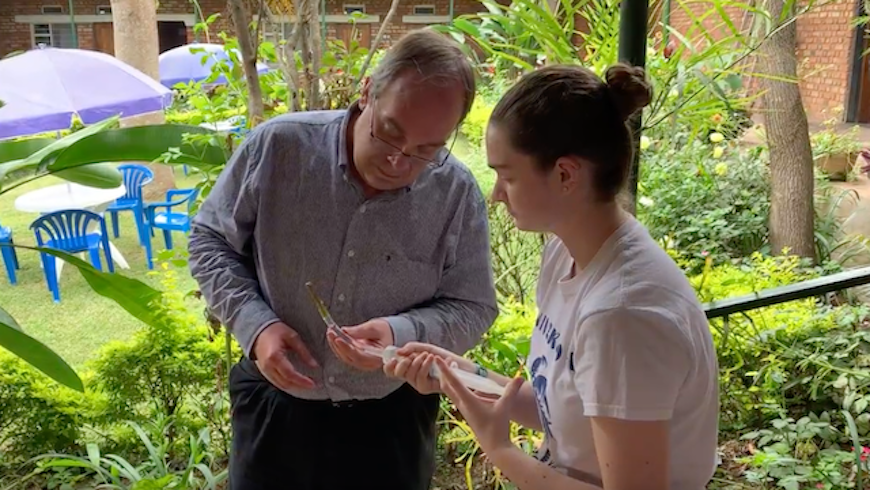
The project took an experiential, international turn when Kozlovsky was part of an eight-student research team with professors Bolender, Jacobitz, biology’s Keith Macdonald and nursing’s Martha Fuller, PhD, in Uganda in January 2020. There Kozlovsky did bacteria testing using local items such as eucalyptus to sharpen the user-design experience.
“I took the water samples we’d get and run them through plant xylem, testing to see if the bacteria increased or decreased,” Kozlovsky said. “Ava and I want this device to be sustainable in Uganda using locally sourced products. Getting the chance to come to Uganda and test the trees most found here is extremely helpful.”
They had a prototype in place prior to Kozlovsky’s trip to Uganda and, upon Kozlovsky’s return, the two kept working through spring until they had to shift due to the COVID-19 stay-at-home mandate. The week before classes went remote in mid-March, Bellizzi and Kozlovsky spent a lot of time in the engineering machine shop to finalize design work on the device so they could perform tests from home.
“We tested the flow rate using applied pressure from household items such as bricks, hand weights and textbooks, anything to provide a heavy force to the system,” Bellizzi said. “This device will be used in Uganda households and not in a lab so people in Uganda are more likely to use something like a brick. This helped us better understand the user’s perspective.”
Making the Most of the Opportunity
COVID-19 might have kept them off campus, but their work ethic paid dividends a few times over by the end of the semester. They presented at USD’s Creative Collaborations in April, at the Engineering and Computing Showcase in early May and then at the Sigma Xi Scientific Research Honor Society’s Virtual Student Scholars Symposium in mid-May, where the two won the Undergraduate Division category.
“The care, motivation and dedication to create a really good presentation reflects on the work they’ve done throughout the project,” Jacobitz said. “Knowing what might work and what doesn’t, shows me a lot of self-motivation and dedication to move the project forward.”
Bellizzi and Kozlovsky did their part while at USD. They’ve got a solid experiential learning opportunity to draw from, they worked with supportive faculty and they made the most of the benefits of the engineering school’s unique BS/BA dual degree.
“This project would not be where it is without the support of the faculty,” Kozlovsky said. “The level of faculty interest and support they give to students shows what’s important to them. I think it shows how much USD cares, that it is about educating the student as a whole. They’re not spitting out a carbon copy of an engineer. The dual-degree program helps us grow, faculty support helps us figure out who we want to be as engineers and what engineering means to us.”
— Ryan T. Blystone