
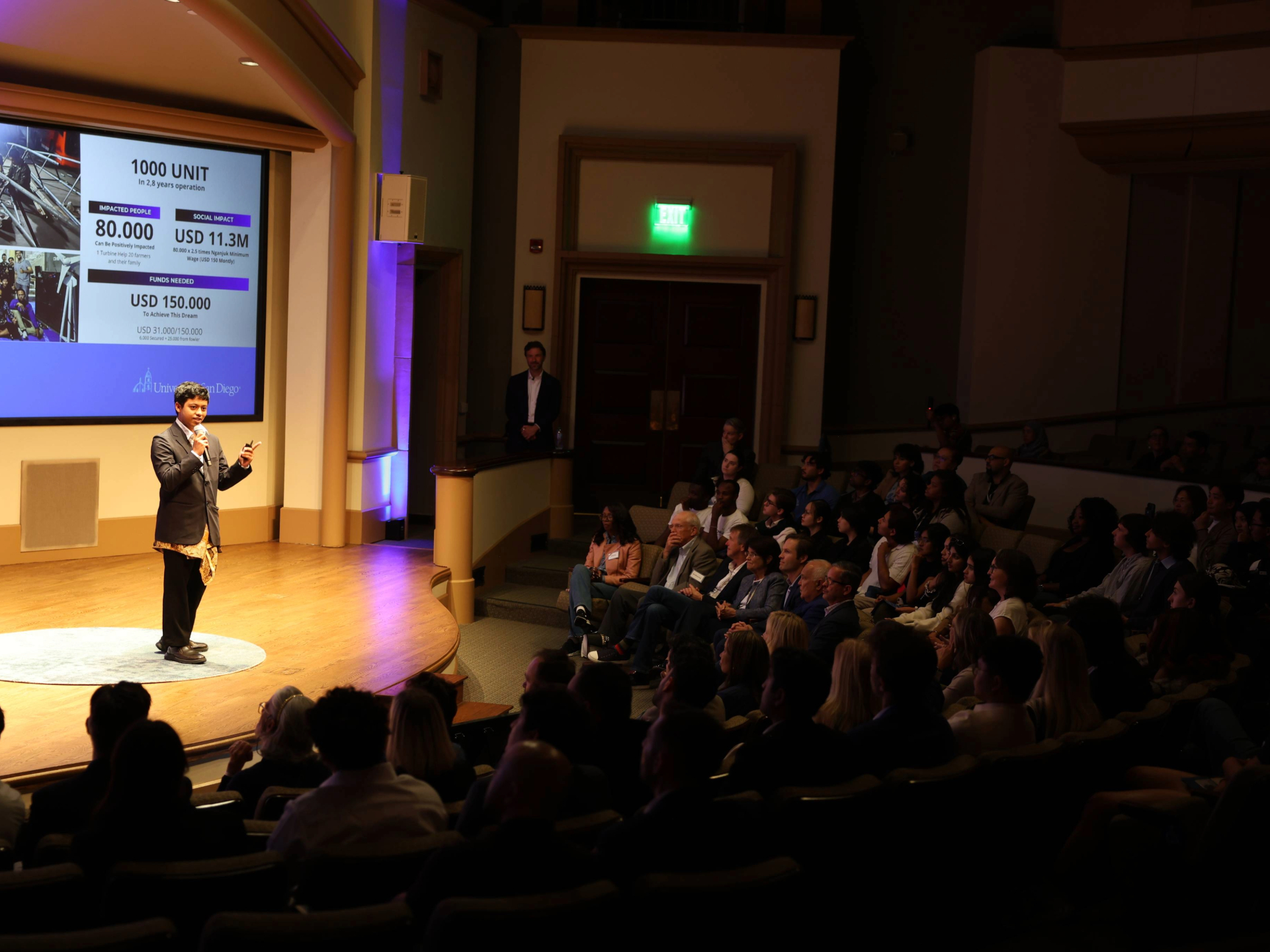
Students Deliver at 2026 Fowler Global Social Innovation Challenge
This weekend at the University of San Diego truly was the vision of The Fowler Global Social Innovation Challenge (FGSIC) realized.
Students had flown in from around the world — Ghana, Indonesia and more — and were presenting on innovative ideas touching on everything ranging from healthcare for the underserved to sustainable farming.
After a whirlwind weekend, and a slate of impressive pitches from finalists, the competition’s namesake was left with a sense of optimism.
“When we come and listen to you students, listen to your ideas, there’s far more faith in the future,” said Ron Fowler, chair emeritus of USD’s Board of Trustees. “To the students who put themselves out there, to the students who have belief in their ideas and how they can impact the world, I say thank you.”
All the contestants are tasked with showing how their business ideas align with one or more of the United Nations Sustainable Development Goals, and pitching a panel of judges for thousands of dollars in seed funding.
The 2026 FGSIC was as competitive as ever. One finalist transformed coconut by-product into a farming material, cutting down on waste and promoting sustainable agriculture. Another student had a business that made a child-friendly tool that helps measure grip strength and improve pediatric rehabilitation.
This year, the winning team was ApexStride, a group of students whose company develops 3D printed prosthetics designed to work in difficult climates, and to be manufactured for lower costs, to improve accessibility. They went home with the top prize, $25,000 in seed funding that will help them expand production to help more people in need. The team’s representative, Ahmed Sajidan Jarjis Rafsan, said he found out just days before that he’d punched his ticket for the FGSIC finals, and said on top of the prize money that the atmosphere of the competition was motivating.
“It’s an ecosystem of passionate, lovely entrepreneurs. I think I’m more inspired, and (I’ve channeled) that energy. Because there were so many deserving candidates. It shows how innovation and an idea can go places,” he said.
The Fowler GSIC is organized in partnership between the University of San Diego and The University of St. Thomas. It started in 2011 with only USD students and expanded into a global pitch contest in 2018. Since 2011, the challenge has connected more than 3,000 students from more than 25 countries. To date, more than $1 million has been distributed to seed the most innovative global ventures.
Rooted in the UN Sustainable Development Goals, the competition provides visibility and tangible support to Changemakers with a passion to make the world a better place. Teams are made up of students with a wide range of backgrounds and expertise, giving them unique perspectives about how to tackle pressing issues.
“What young people understand is that our world is inherently interdisciplinary, that the challenges we face touch across multiple disciplines,” said Andrew Biros, EdD, senior director of social innovation at USD. “And when young people assemble to address a large, systemic challenge, what brings me so much inspiration is that they do it by forming a team. Social innovation is a team sport.”
Virginia Nelson ’79 (JD), vice chair of USD’s Board of Trustees, was one of the judges, and said she had a difficult time picking between the finalists.
“There were so many great ideas in so many different areas. And the students really care about what they’re doing. We were all very impressed,” she said.
Here is a list of the FGSIC finalists and the top finishers. All finalists walked away with at least $3,000 in seed funding. Additionally, 10 other teams were awarded $1,000 idea grants, courtesy of Wendy Gillespie and the Capdevilla Gillespie Foundation.
-
ApexStride (1st Place): A social enterprise providing affordable, climate-adaptive prosthetic limbs and continuous mobility care for underserved populations in Bangladesh
-
Coco Core (2nd Place): Social venture that converts coconut husk waste into premium coco coir growing media – a sustainable alternative to peat moss.
-
Power of Play (3rd Place): Created child-friendly tool to accurately measure grip and pinch strength in young patients.
-
Moneylink: A platform that enables fast, affordable international payments across Africa and its diaspora by leveraging U.S. Dollar-backed stablecoins.
-
Recalivape: A platform that uses data and monitoring to help people quit nicotine use.
-
Terangin: Develops microgrid systems, powered by renewable energy sources, for rural farmers.