
Center Staging Connection
A Cross-Disciplinary Exploration of Philoctetes and Political Reconciliation
Could you work with people who deeply harmed you if it benefited the greater good?
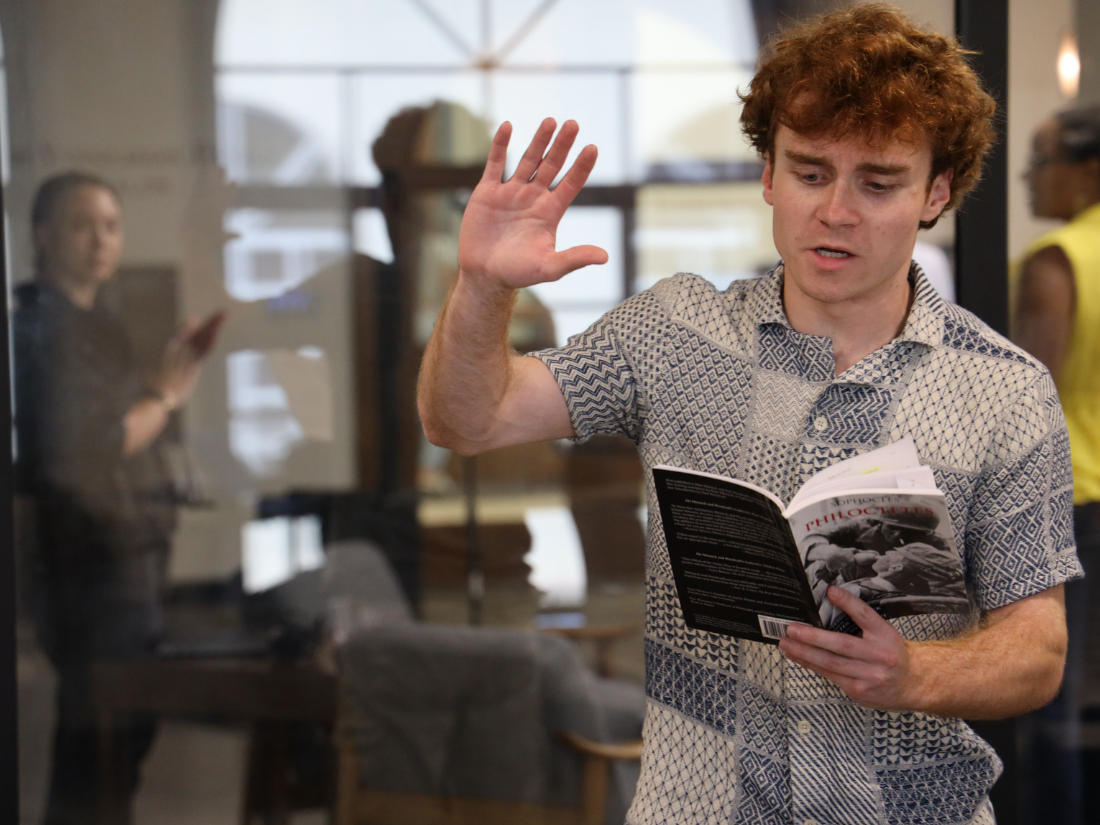
The faculty members and students of the Tragedy of Democracy and the Politics of Compromise — a cross-disciplinary pop-up course — grappled with this question as they worked to put together a “plecture” for the University of San Diego’s 2024 Pearson-Chambers Lecture Series last fall. The plecture — a play and a lecture — is the brainchild of Associate Professor of Political Science and International Relations Tim McCarty, PhD.
Last summer, McCarty approached the USD Humanities Center and Department of Theatre with an idea to collaborate on a pop-up course focused on Philoctetes — a play by the ancient Greek dramatist Sophocles. The final project of the course would consist of a performance of key scenes from the play embedded within a lecture. Assistant Professor of Theatre Jersten Seraile, MFA, joined forces with McCarty to co-instruct the six-week course.
“We created a real ensemble. Even if folks weren’t acting in the scenes, everyone contributed so much of their time and energy to this,” explains Seraile. McCarty and Seraile functioned more like facilitators than instructors throughout the process.
Students like Lily Anderson ’25 (BA in communication) enjoyed the collaborative structure of the course. “We just kind of figured it out week by week and pieced it all together. It was fun being a part of this, not only as a student, but also in helping direct the class as well,” says Anderson.
While the development process of the performance empowered students, the meaningful text impacted them the most. Philoctetes tells the story of a Greek archer who is abandoned by his countrymen due to a painful and unhealed snake bite. Cut off on an island, he struggles to survive alone for 10 years. The Greeks eventually return for Philoctetes when they realize they need him to secure a victory against the Trojans.
“How do you take someone who has been wronged so deeply and persuade them to rejoin the political community that has wronged them?” asks McCarty. “I think that the way the play depicts that is a really thought-provoking kind of approach to this sort of question.”
The Greeks try a number of different strategies to get Philoctetes to go with them, but to no avail. The hopelessness of the situation felt uncomfortably familiar to many of the students, faculty members and attendees of the plecture. “I think certain people are feeling very tragic about democracy right now,” explains Anderson.
It is this discomfort that Seraile and McCarty hoped would spark thought and dialogue for their class and the attendees of the plecture. “Why do people who have been harmed by American democracy continue to show up at the polls? Continue to keep fighting for a more just society? Why don’t they just give up?” asks McCarty.
“Engaging with a play like this — it encourages us to come together in shared vulnerability, come together in ways that make us human.”
It is this discomfort that Seraile and McCarty hoped would spark thought and dialogue for their class and the attendees of the plecture. “Why do people who have been harmed by American democracy continue to show up at the polls? Continue to keep fighting for a more just society? Why don’t they just give up?” asks McCarty.
Philoctetes does end up rejoining the Greeks, but it is at the behest of his good friend, the god Heracles, who magically appears when all hope seems lost. Students are often conflicted by what appears to be an easy resolution, but McCarty and Seraile believe the ending is revelatory and offers insight on navigating our own political strife.
“It suggests that it might take miracles to reconcile our political problems. The human-scale political strategies tried by [the Greeks] don’t work. But if there’s anything at human scale that the play is suggesting can work, it’s friendship,” explains McCarty.
Friendship, however, is not the only theme the plecture explores. “Engaging with a play like this encourages us to come together in shared vulnerability, come together in ways that make us human,” Seraile emphasizes. “We don’t have to face despair alone. We don’t have to be afraid alone.”
That message of community comes not just from the script, but also from the subsequent dialogue inspired by the performance and lecture. “Having conversation with people that agree and disagree helps with building hope. It helps with building community,” says Seraile.
This unique plecture reinforces the importance of collaboration across the humanities. “I think it is really rad that we were able to take two departments together and put the brains of both fields towards a piece,” shares Joshua Kelly, a theatre major and one of the students in the course. “That kind of cross-disciplinary collaboration allows the more exciting work to be produced.”