
Sarah McCormack Studies Sea Anemones to Understand the Human Gut Microbiome
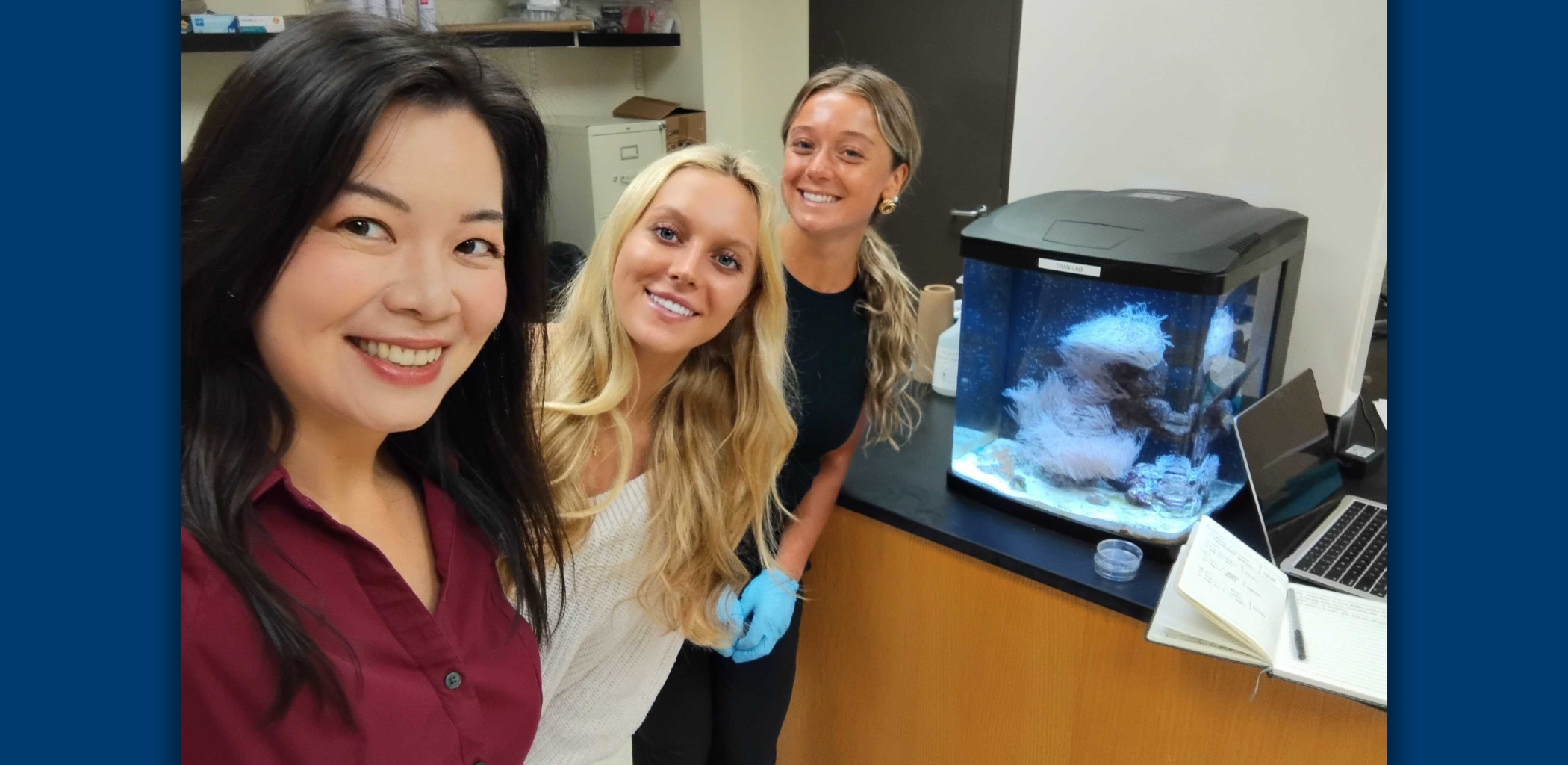
Sarah McCormack's college journey was supposed to be straightforward — earn a Naval ROTC scholarship and enter her career as a physician in the Navy. The Massachusetts native had it all mapped out when she arrived as a first-year at the University of San Diego (USD).
Then everything changed.
McCormack received a medical disqualification in her first year, nearly sending her home. Ultimately, the setback opened a door she never knew existed, leading her to undergraduate research and looking at the microbiomes of sea anemones.
“I really thought that I was going to go back to school in Massachusetts,” McCormack said. “I almost felt like I wouldn’t be challenged anymore, or have much to be proud of if I weren’t in NROTC.”
Yet the biology major stayed.
“Staying really encouraged me to get involved and find other things to fill my schedule.”
During her junior year, McCormack studied abroad in Madrid, Spain. While she was there, she decided to scour USD’s undergraduate research opportunities. One faculty profile caught her attention — Cawa Tran, PhD, whose work in microbiology aligned with McCormack’s interest with holistic health and the gut microbiome, the ecosystem of microorganisms – including bacteria, fungi and viruses – residing in a person’s intestines.
“The gut microbiome has always been something that I'm very interested in,” McCormack said. “In my own free time, that's what I spend my time studying and learning about.”
She hesitantly sent an email to Dr. Tran, and received a quick response inviting her to talk in person. When they met last January, McCormack assumed she'd be studying coral symbiosis, one of Dr. Tran's areas of research.
Instead, Dr. Tran mentioned studying sea anemones to better understand the gut-brain axis in humans.
“I remember thinking, ‘This is literally a match made in heaven,’” McCormack said. “I could not have found a better professor to do research with.”
McCormack said that Dr. Tran gave her freedom to shape her own research project.
“She was like, you can take this research wherever you want it to go,” McCormack said.
McCormack's research explores whether disrupting the gut microbiome affects nervous system activity — a fundamental question in understanding the gut-brain connection. Using Aiptasia diaphana, a species of sea anemone, she tests this relationship through a carefully designed experiment.
First, she treats sea anemones with an antibiotic cocktail to deplete their gut bacteria, while a control group receives only seawater. To confirm the antibiotics worked, McCormack homogenizes each sea anemone — a laboratory technique used in marine biology to break down, blend and create a uniform, liquid suspension of sea anemone tissue — and plates the sample. Healthy anemones produce numerous bacterial colonies; antibiotic-treated ones produce few or none.
“We were able to confirm that the antibiotics were successful in depleting the gut microbiome,” McCormack said.
Fluorescence microscopy reveals the crucial connection. McCormack uses an antibody staining process that targets FMRFamide, a neuropeptide involved in motor control — the chemical signals that tell the anemone's tentacles when to reach out and retract during feeding. A secondary antibody causes these neuronal cell bodies to fluoresce under a microscope. A brighter fluorescence indicates greater neural signaling in the nervous system, suggesting and simplifying the gut-brain axis relationship.
“The hope is that when you deplete the gut microbiome with antibiotics, their nervous systems would become less active, so there'd be less fluorescence,” McCormack explained. In the first trial, her results confirmed this: antibiotic-treated anemones showed decreased nervous system activity.
In the third phase, McCormack introduces a probiotic solution — beneficial bacteria labeled with green fluorescent protein. When she plates tissue samples from probiotic-treated anemones, she sees both their normal bacteria and glowing green colonies, confirming the probiotic successfully colonized their guts.
The payoff comes when she stains these rehabilitated anemones. Fluorescence intensity increases, showing enhanced nervous system activity compared to antibiotic-treated anemones. Even anemones given just water after antibiotics recovered some activity, but the probiotics amplified the effect.
“The richness and diversity of your gut microbiome is essential and important for nervous system activity,” McCormack said. “That's where the gut-brain axis connection is made.”
McCormack recently switched from green to red fluorescent antibody staining to eliminate background interference from the green-glowing probiotics, making the neuronal cell bodies easier to distinguish and measure accurately in her second trial.
The experience has rebuilt her confidence after her initial setback as a first-year. It gave her hands-on lab experience and clarified her future direction. McCormack offers advice to underclassmen who might be hesitant to begin looking for research opportunities:
“You have to believe in yourself and do it,” McCormack said. “I reached out to tons of professors. You just have to make those connections and see what options are out there for you.”
She arrived at USD expecting one path. A medical disqualification forced her onto another. Now, preparing to graduate this May, McCormack recognizes the gift of her redirection.
“Everything happens for a reason,” she said. “I probably would not be in this spot that I am right now if everything had gone ‘according to plan’.”