
College of Arts and Sciences Faculty Gather to Advance Academic Excellence at Cluster-Theme Symposium IV
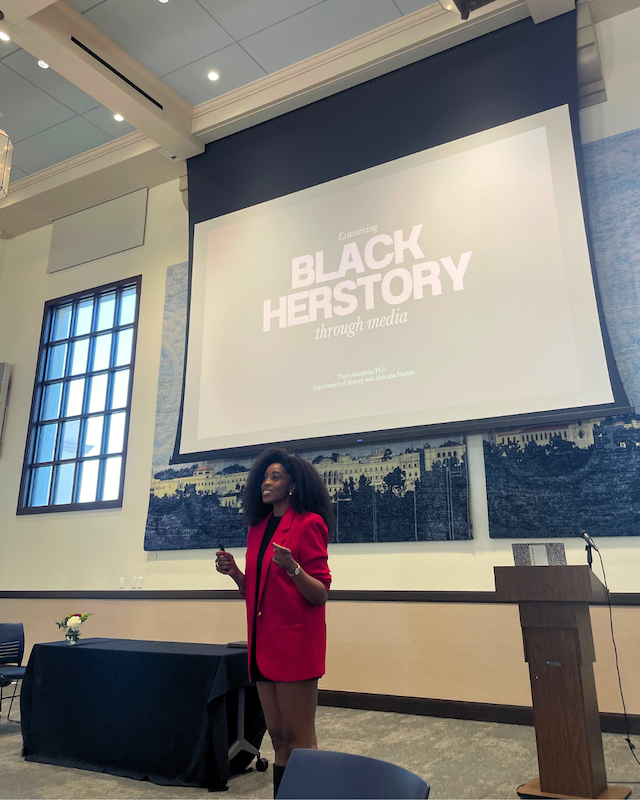
Dozens of University of San Diego (USD) faculty members gathered for engaging panel discussions at the College of Arts and Sciences (CAS) fourth Cluster-Theme Symposium in the USD Ministry Center on February 7. These thematic discussions focused on climate change and environmental justice, technology and the human experience, and borders and social justice. This symposium gives faculty the opportunity to share their teaching experiences and research and convene across disciplines they may not normally encounter.
“We are in a niche career field, and it is important for us to build relationships with others who understand the work that we are doing,” says Matthew Vega, PhD, assistant professor of theology and religious studies. “We share a common context as professors at USD and as experts in our fields. Academia can be a lonely place, and being able to come together and nerd out over the things we love — and to be heard by people who care — is a life-giving exercise.”
Vega gave a lecture titled “Mestizaje and Blaxican Theology.” Grounded in the theme of Borders and Social Justice, the lecture explored how Blaxican theology confronts the erasure of Blackness within mestizaje (racial and cultural blending) and reframes identity as a self-defined, hybrid theological space. He was one of the many professors who tackled difficult social, environmental and political issues prevalent in the world today.
Associate Professor of Architecture Marcel Sanchez Prieto, MArch, presented on pedagogical conditions in the border context related to his work with the Transborder Association of Architectural Education. “The talk highlighted collaborative studios, fellowships, publications and exhibitions as ways to treat the border as both a classroom and an archive of accumulated knowledge and a laboratory for new forms of practice,” Sanchez Prieto says. “Gathering around these topics allows faculty to share methods, build institutional trust and collectively rethink how architecture responds to conditions of inequality, mobility, environmental risk and care — issues that increasingly define contemporary practice beyond the border itself.”
The College of Arts and Sciences launched the Cluster-Theme Symposium in 2022 with the intention of building strong relationships between professors and fostering mentorship for new CAS faculty members. These connections have often led to the creation of grants to support various academic endeavors and research.
"The symposium is an opportunity for faculty to identify partners for team-teaching or inspire future collaborations on scholarly projects,” says Associate Dean and Professor of Communication Kristin Moran, PhD.
The university’s cluster-hiring strategy is a part of the USD Horizon Project, a strategic initiative aimed to increase faculty diversity and inclusion. By the fall of 2026, the Horizon Project aims to make USD a recognized Hispanic-Serving Institution, one of the 100 most diverse, independent universities in the country and a leader among Catholic peer universities in the enrollment, retention and graduation of students of color.
The themes and discussions at the symposium encapsulate the liberal arts approach at the heart of USD.“The symposium helps foster interdisciplinary conversation and collaboration,” says Jillian Tullis, PhD, associate dean and professor of communication. “The cluster themes highlight the breadth of the liberal arts and its contribution to addressing our society’s urgent challenges.”
— Kristiana Phillips