
Professor Emerita, Theology and Religious Studies
- PhD, University of Hawai‘i, Manoa, Comparative Philosophy
- MA, University of Hawai‘i, Manoa, Asian Studies
- MA, University of Hawai‘i, Manoa, in Asian Religions
- BA, University of California, Berkeley, Oriental Languages (Japanese/Chinese)
- She studied at the Library of Tibetan Works and Archives and the Institute of Buddhist Dialectics in Dharamsala, India for 15 years.
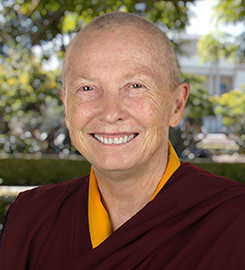
Karma Lekshe Tsomo, a specialist in Buddhist Studies, taught at USD from 2000 to 2022 and was designated Professor Emerita in 2023. She received the University Professorship in 2015-2016, Fulbright Senior Scholar Research Award in 2014-2015, Fulbright Research Scholar Award in 2009-2010, and Numata Professor of Buddhist Studies at the University of Hawai‘i at Mānoa in 2023. She offered classes in Buddhist Thought and Culture, World Religions, Comparative Religious Ethics, Religious and Political Identities in the Global Community, Negotiating Religious Diversity in India, and Death, Dying, and Social Justice. Her research interests include women in Buddhism, death and dying, Buddhist feminist ethics, Buddhism and bioethics, religion and politics, Buddhist social ethics, and Buddhist transnationalism.
Scholarly Work
Professor Tsomo’s doctoral research focused on death and identity in China and Tibet. She authored Sisters in Solitude: Two Traditions of Monastic Ethics for Women; Into the Jaws of Yama, Lord of Death: Buddhism, Bioethics, and Death; Women in Buddhist Traditions; and numerous articles, including “Buddhist Musings on Nondualism,” “Japanese Buddhist Women in Hawai‘i: Waves of Change.” and “Death and Dying in Buddhist Cultures.” In addition, she edited Buddhist Feminisms and Femininities; Eminent Buddhist Women; Buddhist Women and Social Justice: Ideals, Challenges, and Achievements; Innovative Buddhist Women: Swimming Against the Stream; Buddhist Women Across Cultures: Realizations; Out of the Shadows: Socially Engaged Buddhist Women; Sakyadhita: Daughters of the Buddha; and numerous other works on women in Buddhism. She produced several educational videos: “Sacred Ground: Consecrating a Village Temple in Spiti Valley,” “Women in Buddhism: Unity and Diversity,” and “Living and Dying in Buddhist Cultures.”
Professor Tsomo continues to integrate scholarship and social activism through Sakyadhita International Association of Buddhist Women and Jamyang Foundation, which supports education for girls and women in the Indian Himalayas, Bangladesh, and other developing countries. Currently, she is developing La’i Peace Center on the North Shore of the island of O’ahu in Hawai‘i.
Areas of Interest
Professor Tsomo emphasized a dialectical approach to teaching, encouraging students to investigate the assumptions they bring to the study of religion and to dialogue on the fundamental questions of the human experience. She incorporated comparative and experiential approaches, including field research at local churches, temples, synagogues, and mosques. Her classes raised questions about the role of religion in contemporary life, including issues of race, privilege, gender, environment, economic ethics, politics, and violence. She encouraged active discussion on issues of global concern, such as secularism, fundamentalism, religious syncretism, and inter-religious dialogue.