
Student Reflections
In order to assist you in your faith journey, each Sunday we will post a different student reflection that is based on the themes of the Sunday readings. Our hope is that these reflections will provide insight into how the readings connect to our lived experience. We invite you to visit this page weekly for spiritual nourishment.
Readings
- Jer 20: 10-13
- Rom 5: 12-15
- Mt 10: 26-33
Reflection
Throughout his life, the prophet Jeremiah faced persecution by people who tried to silence him as he warned them about God’s punishment if people did not stop worshiping the false god Baal. In today’s first reading Jeremiah tells us how he feels rejected, despised, and criticized by the community. He tells us how even his friends were watching for any misstep. As a result, he is made to feel deep sadness, anger, and an overall sense of abandonment for delivering the Lord’s message. Yet he goes on to realize that doing God’s will means he has a “mighty champion” on his side. He trusts that, despite going through these trials and tribulations, he will never be alone, and that he is “worth more” than the persecutions.
For most of us, trusting in the Lord and putting our faith in Him is easier said than done. Especially in a fast pace world of instant gratification, it can seem that trusting in the Lord’s love only brings one to endure feelings of sadness, anger, and abandonment.
Therefore, it can seem easier to let oneself give into the relief of approval of others, as offered by and seen in social media. Trusting in others’ approval and gratification can seem more rewarding than trusting in what the Lord provides.
This past year, while on a Tijuana day trip, I had the opportunity to witness the beauty of trusting in the Lord, and the abundance of fruits that trusting in Him comes with. While at Casa de las Memorias, I heard the director of the Center describe how he trusted in the Lord’s love so deeply, that he had no doubt that the necessary amount of medicine, food, and necessities would be provided. He seemed to trust in the Lord’s love so easily and confidently that it was evident that his trust inspired and motivated the rest of the household. It made me realize the power and motivation that trusting in the Lord’s love brings.
In our efforts to please God, we should not be worried about how much attention we receive from others, how many “likes” or comments we receive, or the sum of our material possessions. Jesus reminds us that our worth does not depend on these things. Our God, who gave us life, knows the complete value of our soul which is so much greater than any amount of money or human thought can ever express.
—Maribel Orozco, '20
Readings
- 2 Kgs 4:8-11
- Rom 6: 3-4
- Mt 10: 37-42
Reflection
Today’s readings address the theme of living like Christ through the service of others. The first reading from the 2nd Book of Kings gives an example of how doing something small, such as the woman arranging a room for the prophet Elisha, leads to a blessing later. In the Gospel reading, Jesus speaks about doing smaller actions, such as receiving a prophet or giving water to a disciple, which leads to great rewards later. Living like Christ does not necessarily mean that we must do big, public acts of help and kindness to others. Even the smallest acts of kindness done quietly can make a world of difference. Simply smiling at someone when you pass by them or just asking someone how they are doing when you see them can be all that it takes to change someone’s day.
Series
As I look back on my first year at USD, one of the biggest influences was University Ministry and Founders Chapel. What started as signing up to be an altar server and then a violinist for the Founders Chapel Choir turned into a year-long journey of meeting new and different people and growing in my faith. Even though I was doing something that was quite small in the grand scheme of things, such as being an altar server at the Daily Mass, it was precisely such small things that added up to something much bigger - helping other people and becoming more like Christ.
One of the times where a small action meant so much more occurred at Christmas time. I was helping to set up the Christmas tree in the Chapel foyer. After spending three hours on the tree, I still felt as though it was not complete. However, everyone else agreed that we were finished decorating the tree, and so we left the tree alone. Throughout the rest of that week, and the following weeks, we heard many compliments from many people saying they thought the tree looked amazing and that whoever did the work did a great job. Even though I did something small, it had a major impact.
As I think about next year, I am aware that I have been greatly blessed to have received a scholarship and be chosen to serve as a UM RA, a role that will allow me to build on the small roles I've already taken on in University Ministry. I am convinced that if we invest in Christ with small acts of charity, the return will be unmeasurable.
—Tomy Vettukallel, '20
Readings
Reflection
In our world today, it can often feel like there is no reprieve from the pain and suffering we all must endure. A heart-wrenching reality for many people with which I struggle to reconcile is cancer and other life-threatening illnesses. Cancer has had an enormous impact on my life and on the lives of my friends and family. The pain, anger, and sadness suffered by my loved ones seems so unrelenting at times that I feel that I have no other choice but to ask God why he allows such pain to occur. And although I wish I had a perfect answer, I do not. But I have found that it is in those moments of pain and suffering, I have also found hope and a renewed faith. Last fall, after months of planning and preparing, I co-coordinated the First Year Student Retreat, a weekend retreat for students about a month into their first semester of college that allows them to reflect on their college experience thus far. Leading up to the retreat, I was confident in our leaders and excited to meet the new students, but terrified that we had forgotten something or that something would go wrong. I wanted it to be perfect: for every person to have a perfect and fulfilling experience. Anything less would have seemed like a failure to me. Is that enough pressure to put on myself and on everyone else involved? Maybe. I tried to control my worries as we boarded the buses, arrived at the retreat site, and began the retreat, but I still kept myself from really being in the moment and enjoying the experience that I was helping to create.
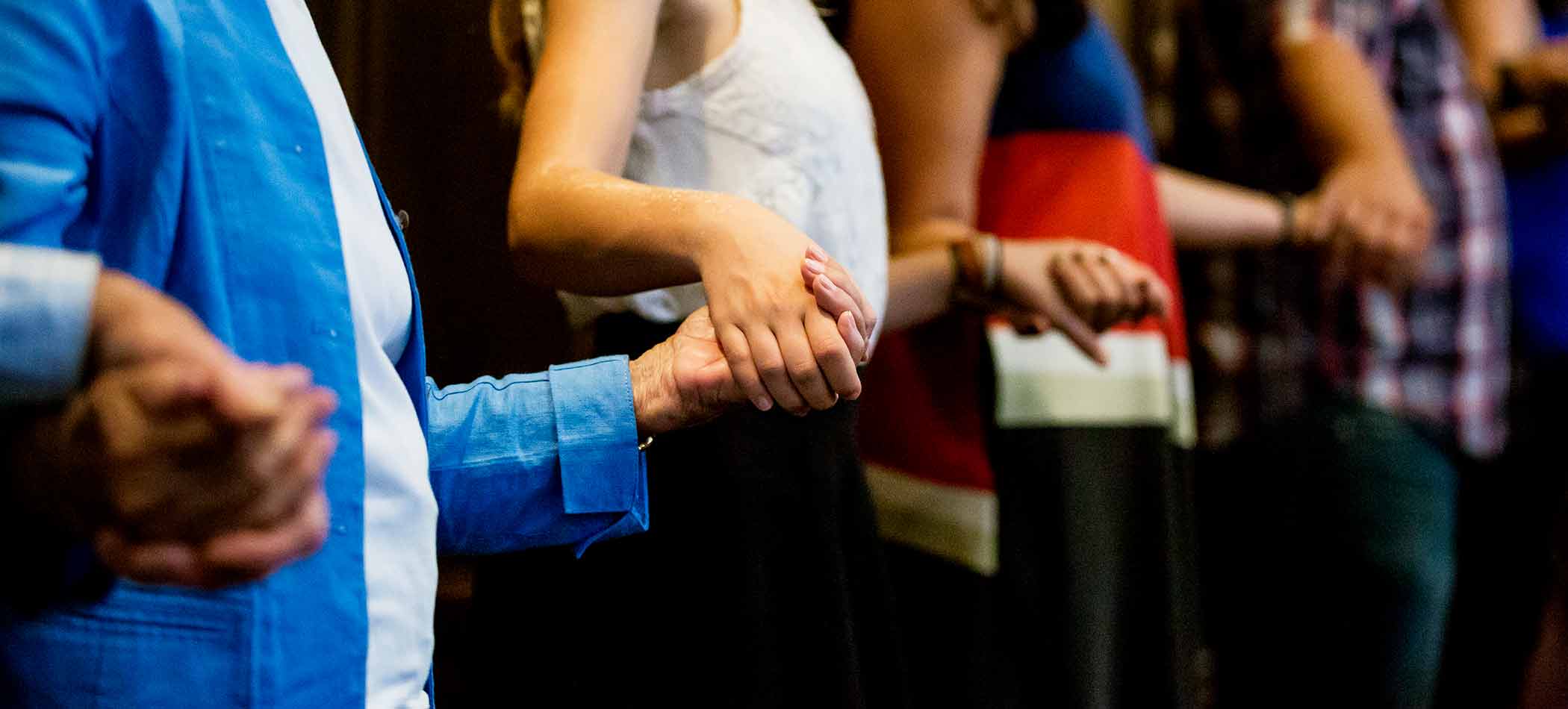
It was not until we did an activity we called the “Circle Activity” that I began to appreciate all the beautiful things that had been happening around me. The group was given a series of prompts about their lives and their college experiences. If a prompt is true for an individual, they can choose to move into the circle. As we participated in this activity, the barriers between us began to fall away. It was in our vulnerability not only that I found peace with our preparation for the retreat and its inevitable imperfection, but also the beautiful friendships that we had just created. The community that we had just forged gave me reassurance for the struggles that I had endured and hope that this community would support its members during future moments of pain.
I do not know the answers and although I wish I could control the future, I will not be able to make it perfect. But maybe we are not meant to understand. Maybe we are just meant to have faith, and have faith trust Jesus’ words from today’s gospel:
“Come to me, all you who labor and are burdened,
and I will give you rest.”
—Alex Annen '18
Readings
Reflection
As I was driving home from summer school this week, the announcer on the radio said something that really hit home for me. He had just finished a phone call with someone who was going through a rough situation when he said: “When you think that you are broken inside, remember that even a broken crayon still colors just fine.”
Those last eight words really hit me, and drove something home that I had been trying to pin down for quite a while now.
Throughout my first two semesters at USD, I was continuously being too hard on myself. I would get on myself for not working on personal projects enough, for not managing my time better, for failing to work on some of my bad habits, and for not spending enough time with my friends and with God. The list seemed to go on and on, and it got to a point that even my parents asked me if I was okay during my weekly phone calls with them. In a way, I was making it seem as if I was the path, the thorns, or the rocky ground in this week’s Gospel. It was as if I assumed that I would stay that way forever, and that I would never be able to change my ways or get better because I seemed to be doing so much wrong that it would be impossible to fix it all. However, just like how a broken crayon still colors just fine, this Gospel reminds me that I am just a seed, nothing more and nothing less. I have been given many blessings from God, but I am still just a seed. In doing so, it reminds me that I can change the soil that my seed is planted in, but it will take time and effort to change my life just like how it takes time to improve the soil in a field.
A professor of mine once said that the way you eat an elephant is “one bite (it was a programming class) at a time.” He wasn’t speaking of a physical elephant, but of a large challenge, and just like you approach a big problem one step at a time, I have begun to improve my life and the way that I look at myself “one bite at a time.” I have begun to work on creating better habits for myself and getting rid of the bad ones, but I take everything one step at a time.
I understand that I will fall sometimes, but I take each failure as a lesson and keep moving on. With time, I hope to become the person that God wants me to be, and I hope that my seed ends up being in rich soil that allows it to bear much fruit.
As you go through the week ahead, don’t just think about the soil that you are right now. Think about the soil that you want to become. Set reachable goals for yourself. Remember that nothing happens overnight, and understand that failure is just an opportunity to get better. Remember that broken crayons still write perfectly fine, and don’t discourage yourself by getting down on your faults. You are a seed filled with many blessings from God, nothing more and nothing less, and this means that you decide the soil your seed ends up in. Keep working at becoming a better you, and remember that big challenges are overcome one “bite” at a time. Keep working at it, and never lose hope because a positive attitude is always better than a negative one. With time I know you will succeed, and I pray that you are able to stick with no matter where you are or what situation you are in. Have a Blessed Week.
—David Hunt, '20
Readings
Reflection
How much faith does one actually need to gain entrance into the Kingdom of Heaven?
This is a question that I have thought about many times and fortunately, the readings for today shed some light on a possible answer. Reflecting on these readings, I am reminded of the song “Even If” by MercyMe. The whole song is a testament to the ups and downs of life, how important faith is and how forgiving our savior, Jesus Christ truly is. There are moments that seem to require more faith than I poses and there are other moments where life is going really well and faith is the last thing that I think I need. There are a few lines in the song that read, “They say it only takes a little faith to move a mountain. Well good thing a little faith is all I have, right now.” I have felt many times, that I am not strong enough to face the various struggles that are presented before me. However, it is through these struggles that I come to realize how strong I am with God by my side.
The song “Even If” pairs nicely with this week’s readings, offering hope where often it can feel like there is none. I would encourage all of you to take the time to listen to it.
The first line of today’s first reading makes it clear that our God is one who always, no matter the time or place, has our best interests in mind. When we submit to his desire for us, we are often surprised at how happy and content we are. I have had many of these moments, most recently, my acceptance to USD in 2015. Financially, USD was too much for my family to afford and I would need a large financial aid package to be able to attend. I think I prayed harder than I had prayed in a really long time.
When I first visited USD in the spring of 2015, I can remember almost perfectly the immediate feeling of being at home that washed over me. In the beauty of the USD campus I saw Christ and this beauty became a reminder of his consistent presence around me every day. This is why I really wanted to attend this school and it wasn’t until I accepted that Gods will for me might be different, that I was more at peace. When my financial aid package came in, I was pleasantly surprised. USD had offered me more financial aid than all the other schools I had applied for. Just like the second reading suggests, when we become aware of our own weaknesses, and offer those up to God, the Holy Spirit begins to intercede on our behalf. My first two years at USD have been a true blessing. I have met so many amazing people and come to develop a deeper more sincere faith life. I have a family here, and my experience has been everything I dreamed it would be and more.
Perhaps this how the Kingdom of Heaven will be. When I think about the Kingdom of Heaven, just like what USD is to me, the word home comes to mind. A place of comfort, unconditional love, and true lasting happiness. I challenge you all this week to remember that it is okay to admit weakness, especially to the Lord. If we are able to do this, we are rewarded greatly here on earth, but most importantly in the Kingdom of Heaven.
—Elianna Lucas, '19
Readings
Reflection
In this Sunday’s readings, God grants Solomon one request, to which he asks for wisdom. Solomon only wants discernment, that he might be fit to govern God’s people. This request not only exemplifies the wisdom of Solomon in that moment, but also his selflessness and concern for his people. Wisdom is the lens of self-giving love which Solomon strives for.
And through this lens, one can see the infinite value in another person, a value which flows from the image of God in each of us. It is through the acceptance and acknowledgement of this image of the Son in everyone that one becomes a part of the Body of Christ; an individual with many brothers and sisters. The second reading discusses this union, for which all things work because of the love of God. This passage does not dismiss the hardships of a fallen world, but rather embodies hope beyond them.
The Gospel reading describes this hope beyond as something of great worth, that which a person commits the whole self to. A perfect unity grounded in love between brothers, sisters, and God. The love we share now, in the rare moments of perfection, is a glimpse into the kingdom of God.
In practice, I have discovered that our faith of love seeks communion. In my life, I have begun to volunteer at the Bayside Community Center, where I help with the farmer’s market. This process started out as an optional assignment in a theology class with Dr. Mark Peters, yet grew into a fellowship with others. Often a nearby vendor named Jeff and I will tell each other jokes and check in with how everyone’s family is doing. Amy runs the garden so she will drop by with her dry humor and liven things. My supervisor, Kim Heinle, leads with a cheerful optimism. And while selling produce to the locals of Linda Vista is no extravagant expression, the love I have found there in talking with the people has inspired me to continue volunteering.
More recently, I was confirmed this last May. My confirmation in college (albeit somewhat later than usual) has been a transformative time in my understanding of my faith. Through these two experiences, I have learned that the love of God extends well beyond comfort zones. My encouragement to others is to adhere to this love as it traverses those comfort zones – for the love of God, where ever it is found, is truly a treasure.
—Jordan Castro, '19
Readings
Reflection
In Matthew 17, verses one through nine, Jesus leads Peter, James, and John up onto a mountain. After arriving at the summit, a great transfiguration happens: Jesus becomes bright as the sun and God appears in the form of a glaring cloud that sternly instructs the fearful witnesses to listen to His son, Jesus Christ. The three witnesses experience a plethora of emotions after seeing the power of God and His interconnectedness to His son.
The fascinating part of this passage to me is not the transfiguration but rather Jesus’ request of the disciples as they descend from the mountain. Jesus asks of the disciples, “Do not tell the vision to anyone until the Son of Man has been raised from the dead.” Now, they may not have fully processed this request at that moment, but I am sure there came a time when they reflected on the wild things they had seen and wished they could tell everybody they knew. I would not be surprised if there was a moment when they thought, “We’re supposed to keep what we just saw a secret? Are you serious?” It is hard enough to keep a friend’s current love interest a secret. Now, imagine trying to keep it a secret when you witness the Son of God turn bright as the sun and then get yelled at by a voluminous cloud that is also the creator of the universe.
Jesus came to earth to save. Although he, time and time again, showcases magnificent moments of God’s glory through healings - curing leprosy, giving sight to the blind, casting out demons, raising the dead from the grave - he ultimately came to pay the price for our sin that nobody else could pay. So, when Jesus tells the witnesses to not tell others of what they saw, he is asking them to do this so that they will focus on the message he preaches and lives and the conquering of death he would achieve, as opposed to his plethora of miracles.
I find the disciples’ experience in this passage similar to what I experience after attending a retreat. After going on both my Kairos retreat in high school as well as the Search retreat at USD, I was on a spiritual high. I came down from the “mountain” and wanted to tell everybody everything about every moment on the retreat. But for those who did not experience what I did, it would not make sense. Nobody can completely relate to the deeply personal experiences. However, I believe the true takeaway from these retreats is not what happens on the retreat but rather how they call and encourage us to live in response. Magnificent moments may occur on the retreats but the primary lesson learned is to lead, live, and love like Jesus did.
Miracles are fascinating, but Jesus’ love and grace is unfathomable. This is why Jesus asked the disciples to not talk about the things they had seen: so that they would focus on what he came to teach and the love he came to give. I believe that this is as applicable today as it was that day on the mountain.
—Garrett Stollar, '18
Readings
Reflection
Stop me if this scenario sounds all too familiar: you are four or five years old and you just got those handy training wheels off of your first bike. A loved one pushes you on the back and you are off to the races. You are pedaling as best as you can and, much to your surprise, you are riding a bike! You are so excited that you forget about the one thing that actually made this dream possible: pedaling. Within seconds of your first bike ride without training wheels, you are crying out to someone for a Band-Aid and some kisses on the fresh bruise you just got on your knee.
This Sunday’s Gospel sounds a lot like riding a bike without training wheels for the first time. It is the story in which Peter walks on water towards Jesus, only to shrink in fear of the heavy winds. Without falter, Jesus saves Peter, causing the other disciples to respond the only way they know how: “Truly, you are the Son of God.” Perhaps Peter’s pedaling is his faith itself. Let us not forget that Peter and the rest of the disciples were just as human as the rest of us, and doubting their faith while having the privilege of experiencing the Son of God firsthand was not a rare occurrence.
Fast forward fifteen years and my doubts are much more worrisome that riding a bike. Last May we said goodbye and good luck to close friends, mentors, and all around good people known as the Class of 2017. I will look back on this class with great appreciation for how they helped form my faith, but one thought looms over my head: I am now the same age as they were when I first met them as a timid first-year student. To make matters worse, one of my best friends just had to point out that we are now the people that students will seek out for guidance and perspective. Yikes. I barely know where Loma Hall is, let alone how to fill the footprints that were left behind!
Just as my feet stop moving and I find myself sinking in my own ocean of personal doubts, I am reminded of one thing: the greatest things in life are found on the opposite side of fear. I can choose to cower in fear of the unknown, or I can trust myself and realize that the experiences that I have shared with others at USD and beyond are more than enough to prepare me for what lies ahead. I don’t know what these next two years will look like exactly, but I have a pretty good idea that if it’s anything like the first two, people could learn a thing or two from me! Amen.
—Matthew Hendrickson, '19
Readings
Reflection
This summer I was blessed with the opportunity to go on a mission trip to Colombia. While there, our group attended a Mass in one of the oldest cathedrals. There is a sacred beauty in attending Mass in a language or culture other than your own. It emphasizes the true universality of the Church. As an American, with a very, very limited Spanish vocabulary, I can walk into a Colombian Mass and know (roughly) what is being done and said and am able to participate, even in my own different language. During this particular Mass, there was a Colombian woman seated across the aisle from our group. And boy, was she full of the Holy Spirit that day. For each response, no matter how quietly others may have mumbled the words, she proclaimed them with such enthusiasm and conviction. When it came time to sing, she sang (albeit quite a bit out of tune). I observed that others attending Mass gave her some disapproving looks and eye rolls, but that did not matter to her. She was there, in the moment, with her God.
I had observed something similar when I visited St. Patrick’s cathedral in New York while visiting a friend from USD. After attending Mass, we walked around the cathedral with the other tourists as another Mass was being held. As I was walking up the left side, observing the different beautifully decorated statues of saints, I was startled by a loud “AMEN!” Out of instinct, my head snapped in the direction of the sound, as did everyone around me. It had come from a woman seated towards the back corner of the church, behind a pillar. From her appearance and the bags beside her, I assume that she was homeless. However, just like the woman in Colombia, she didn’t seem to care how those around her might viewed her. It only mattered that she was there, praising her God in “a house of prayer for all people.”
God doesn’t only want the perfect and the clean. He wants the broken, the messy, the dirty. He made us in his image, and with the free will to decide whether to love and trust Him or not. “For God delivered all to disobedience, that he might have mercy upon all.” We don’t have to always be perfect. We don’t have to have the best voice, or clean, nice clothes to be with him. Just like the Canaanite woman in this week’s gospel, God rejoices when we run to him and say “Lord, help me.” The world pushes us to be complete all on our own, but God wishes for us to be complete in Him.
—Molly McGarvey, '19
Readings
Reflection
I like to plan. I have been planning the fall semester all summer, in regards to meetings, work, visiting home, and other events. Sometimes when I get really eager, I fill in some of my events for next spring. I know it probably seems a little obsessive, but I feel that as a college student, making lists and being organized is the best way to get things done on time. It also gives me the illusion that I have control over my life. With that being said, I have hesitated in the past fully allowing myself to trust God.
It's such a strange desire to want to be in control of our lives when we already have God taking care of it. In today's Gospel, Jesus asks the disciples who the son of man is. Simon Peter is blessed because he responds with, "You are the Christ, the Son of the living God." Simon Peter knew all that Jesus was. I think being able to fully understand who God is and all He wants for us should explain why He doesn't want us to be fully in control.
When I think about God's love for us, I am always left in awe. So why can't I apply these emotions when He puts something unexpected in my life? I think I can control my life because I write everything down, but it only goes so far which is until my plans divert from what God wants. A phrase that gets me through these moments is "Let go and let God." Being resilient is more than a skill, it's having faith and being okay with sudden changes. "If you want to hear God laugh, then tell him you have a plan" is another quote that helps me trust and remind myself that it's not always up to me.
Even though God has so many wonderful moments in store for us, however, we are still responsible for our own actions. Jesus grants all authority to Simon Peter, and I've learned with more power comes much more responsibility. Among leadership, I have learned that it is not a title that you hold nor the power that comes with it, but it is guiding others to find their best and truest self.
Everyone at USD is a leader in a different capacity, and it's so inspiring to see this in so many of my peers, empowering one another and helping each other grow. Truly, we are in fact servant-leaders, being instruments of God by leading and accompanying those around us growing in compassion, community, and making it a world that reflects that.
—Lissette Vasquez, '18