
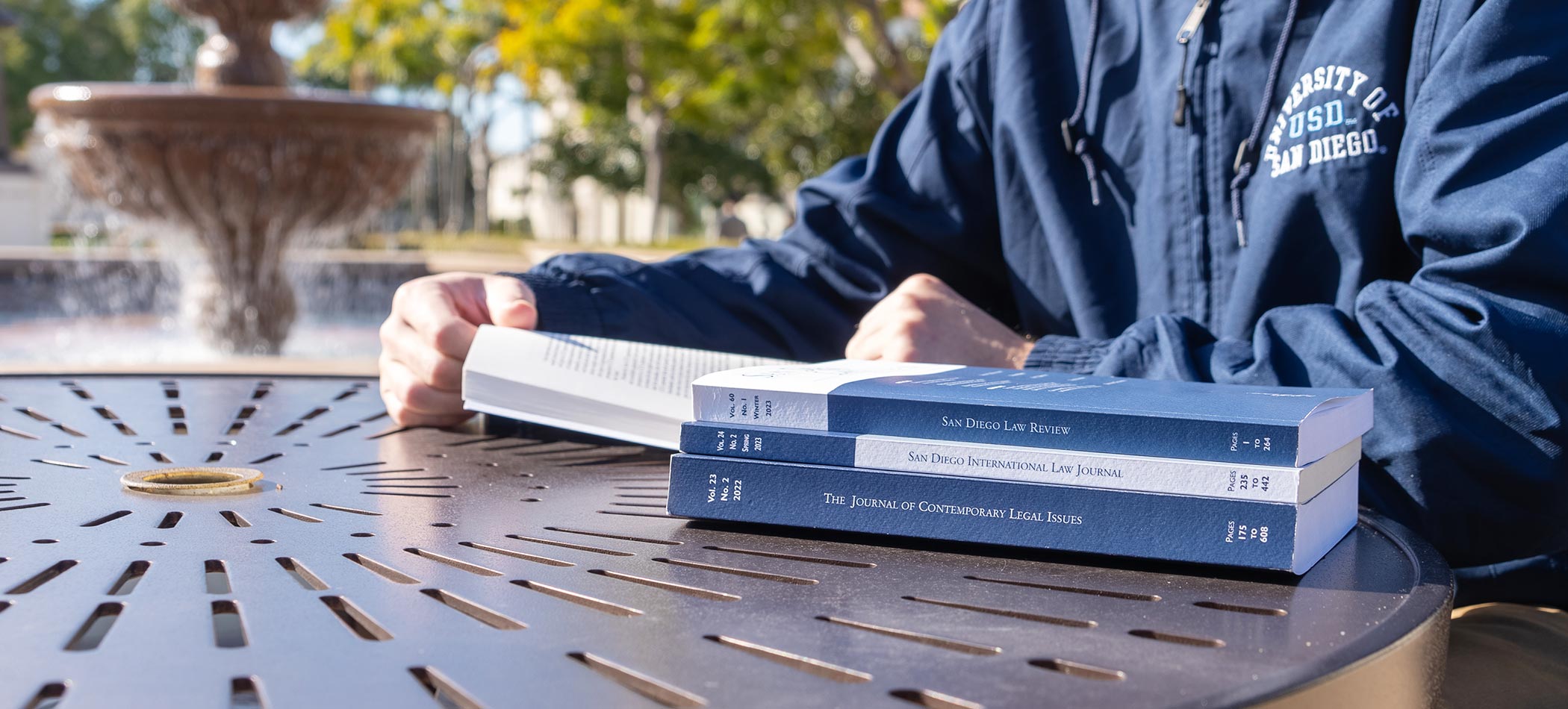
Membership on one the USD School of Law’s law journals is both an academic honor and an excellent learning experience. Members enhance their legal research and writing skills by writing an independent comment and assisting with the publication of each issue. Membership requirements depend on the journal.
Concurrent Degree Students
Each journal determines their own write-on policies (see table below). Concurrent degree students must participate in the writing competition at the end of their first year of their JD studies. Concurrent degree students who are successful in the write-on competition will then defer their placement on the journal until they return to residence at the law school. Concurrent degree students may be permitted to complete their citechecking during their year in residence at the graduate school since it does not require you to enroll in credit. The journal Comment, which will satisfy the upper division writing requirement, may only be completed while in residence at the law school (basically your 2L year (third year overall)).
Note: The Journal of Contemporary Legal Issues has its own unique membership process. Visit the JCLI Page for more information.
| Journal | Membership eligibility | How to join |
|---|---|---|
| San Diego Law Review | Only full-time, concurrent degree, or part-time students entering their second year are eligible for acceptance to the San Diego Law Review. SDLR membership is a two-year committment. | Participation in the annual write-on competition at the conclusion of the first year of JD studies. Automatic invitation to top 2.5% of the 1L full-time class at the end of the first semester; top 5% at the end of the second semester. |
| Journal of Climate and Energy Law | Full-time, concurrent degree, or part-time students entering their second year are eligible for acceptance to the Journal of Climate and Energy Law. | Participation in the annual write-on competition at the conclusion of the first year of JD studies. Automatic invitation to top 10% of the 1L full-time class at the end of the second semester. |
| International Law Journal | Only full-time, concurrent degree, or part-time students entering their second year are eligible for acceptance to the San Diego International Law Journal. | Participation in the annual write-on competition at the conclusion of the first year of JD studies. Automatic invitation to top 10% of the 1L full-time class at the end of the second semester. |
To be considered for membership, all students (including Concurrent Degree Students) must participate in the annual write-on competition at the end of the first year (unless automatically invited for membership by the San Diego Law Review for ranking in the top 2.5% at the end of the first semester and the top 5% at the conclusion of the second semester). The write-on competition is a cooperative effort between ILJ, JCEL, and the SDLR that enables interested students to apply to all journals at the same time.
Membership FAQs
The San Diego Law Review, the Journal of Climate and Energy Law, and the International Law Journal are student-run publications directed by their respective Editorial Boards. Editorial Boards generally consist of an editor-in-chief, a managing editor, a chief articles editor, a chief comments editor, articles editors and comments editors (although the SDLR employs an expanded editorial board).
Assistant Director for Law Journals, Brigid Bennett, oversees the production of each law journal. Email Brigid with any questions at bbennett@sandiego.edu.
The number is not predetermined. However, between 25 to 45 students are generally accepted per journal.
It depends. View the table above for each journal’s respective eligibility restrictions.
Participating in a law journal is a substantial responsibility. All student members are required to complete one "Comment" (a research paper intended for publication). The Comment will discuss an interesting and hopefully controversial topic in law and will be at least 30 pages in length. Every student on receives personalized editing assistance on the comment from a member of the editorial board.
Every Comment is reviewed by the respective journal’s Student Article Publications Committee. Papers that are determined to be of exceptional quality and interest will be selected for publication in the respective journal. Publication in a law journal is a distinction that will remain with the student throughout his or her legal career.
All members are required to assist in the editing and preparation of articles for publication. Members review the accuracy of the research in every article selected for publication, from both institutional and student authors. Reviewing articles is a very important task because it ensures the quality of the publication.
Successful completion of every law journal assignment will result in two units of academic credit during the second year of law school. More units are available if students wish to publish a Casenote or to become members of the editorial board.
The editorial board is selected by the outgoing editorial board from within the respective journal’s membership ranks. Membership on the editorial board is an honor and requires a significant time commitment.