
Spring 2023
The Allure of Azure: Mystical and Spiritual Associations of the Color Blue
Curated by Aldara Velasquez ('24), Fall 2022 Print Room Intern
Artists across cultures and historical time periods have used the color blue to allude to a higher power or a mystical element in their work. In ancient Mexico, the Aztec people used turquoise stones to demonstrate the presence of gods in their artworks and jewelry. During the 14th and 15th centuries in Europe, artists used a hard stone called lapis lazuli, mined in Afghanistan and exported through the Mediterranean world and South Asia, to create a deep blue pigment called Ultramarine. This prized color was most often used in religious artwork to portray divine figures such as the Virgin Mary due to its symbolic associations with both the skies and royalty during this period. In the 20th Century, artist Yves Klein discovered a new hue of blue and used it to create body prints on canvas. These prints demonstrate the absence of the body and therefore open a discussion regarding the metaphysical. The color blue has been associated with peace, healing, tranquility, and imagination and is, therefore, deeply connected with spirituality. This exhibition celebrates this connection in many different contexts.
(American, 1918-1986)
Corita Kent
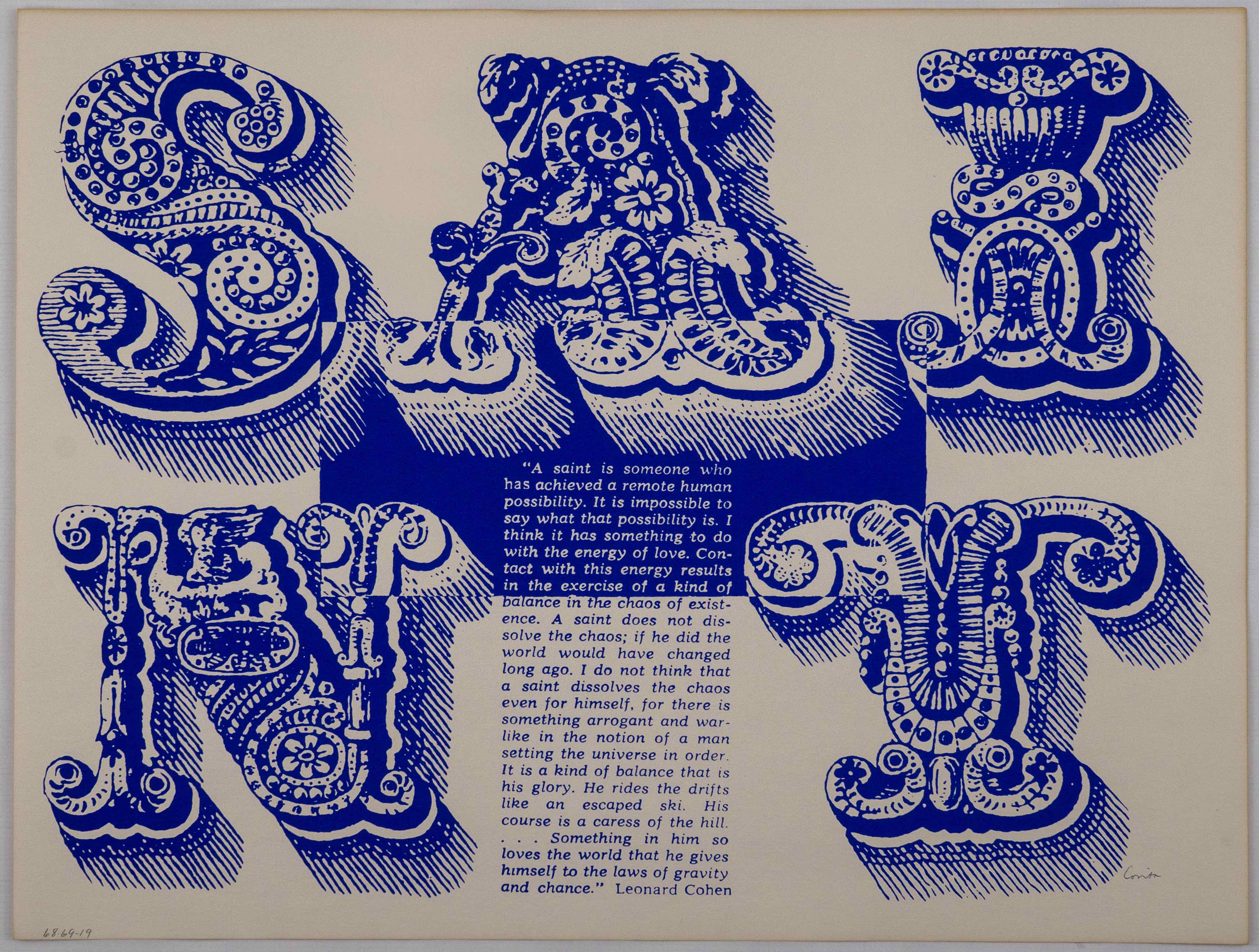
Corita Kent was an artist and educator who entered the religious order Immaculate Heart of Mary in Los Angeles when she was 18. This work was created the year she left the order and moved to Boston. A deeply spiritual person throughout her life, her work utilizes religious imagery in contemporary depictions. This print is made up of a blue rectangle in the middle, surrounded by the white of the paper. The word "SAINT" is written in an elaborate font in blue across the print. In the bottom half, between the letters N and T, there is a Leonard Cohen quote: "A saint is someone who has achieved a remote human possibility." The use of color references traditional western uses of Ultramarine, while the abstract, text-based composition pushes this work into conversation with other contemporary artists working in the 1960s.
(Mexican, 1852-1913)
Jose Guadalupe Posada
Born in Aguascalientes, Mexico, Jose Guadalupe Posada was best known for his use of relief printing to produce illustrations. He studied at La Academia Municipal de Dibujo de Aguascalientes (the Municipal Drawing Academy of Aguascalientes). Posada went on to apprentice under Jose Trinidad Pedroza who taught him lithography and engraving. His work uses traditional Mexican imagery as well as religious images, and his subject matter takes form in illustrations for posters, flyers, brochures, and books. This work mimics a flyer that might be handed out during mass with a verse. "A La Santisima Virgen de Guadalupe" is on the recto of a blue-colored sheet of paper. This washed-out blue tone evokes familiarity, and the imagery of the Virgin of Guadalupe and the accompanying text allows us to understand the setting in which it might be presented, for example, during mass.
(American, b. 1994)
Sammie Cetta
Sammie Cetta’s work is primarily connected to her relationship with the sun, literature, and herself. As part of a collection titled A Change of Light, this work attempts to connect the gap between the present and the hope of the future. This collection rids itself of figurative images and turns to lines on a page. These lines represent hope or potentiality found in the sky. Below this grid, a quote from Julio Cortazar’s A Change of Light and other stories (1978) reads:
at some moment, there will be the silence of the
darkened house, only the church clock, a distant horn,
because the neighborhood is quiet.
American, 1842-1924
Frederick Stuart Church
The son of a political figure and lawyer, Frederick Stuart Church was an American artist and illustrator. His work is well known for the use of allegorical depictions of animals. He dedicated his life to his art following his discharge from military service after the civil war. The Snow Image is inspired by Nathaniel Hawthorne's fantasy tale of the same title. The tale tells the story of a pair of siblings who create a snow girl that magically comes to life. This work exemplifies the transcendent quality associated with the color blue. The etching shows the young snow girl in a swirling dress with birds flying out of her hand. The movement created in this composition heightens the feeling of transcendence created though the color.
Past Projects
Spring 2022
A Floating World of Art: Japanese Woodblock Printing and its Contemporary Influences
Curated by Ana Aguilar Gonzalez, Blythe ter Kuile, Amelia Leahy, and Elie Nguyen (Class of 2022)
Japanese woodblock printing during the Edo period
Characterized by an increase in wealth and consumerism, the Edo Period in Japan (1600-1868) witnessed the rise of ukiyo-e prints, or pictures of the floating world. Ukiyo-e focused on leisurely scenes from daily life, courtesans, popular Kabuki actors, and landscapes. Edo-era printmakers took on their own unique identity, mastering full-color prints in the 1760s and incorporating satire and humor in their work. Woodblock prints catered to the masses, responding swiftly to emerging fashions by being made cheaply, quickly, and in large production runs. Made to be consumed, ukiyo-e prints were purposefully ephemera, capitalizing on the self-renewing property of their demand. In 1842, ukiyo-e printmakers faced an obstacle when the shogun’s ministers sought to restore stability within the country by placing restrictions on the print trade, seeing it as a manifestation of immorality and extravagance. Still, the printmaking industry adapted nimbly through strategic retitling, disguising Kabuki actors as historical heroes, for example. In the 1830s, landscape prints became popularized through artists such as Hokusai and Hiroshige. Throughout the 19th-century, ukiyo-e began incorporating European pictorial techniques and, in turn, influenced European and American artists with the advent of international trade in Japan.
(Japanese, 1769-1825)
Utagawa Toyokuni
Born the son of a doll and puppet carver, Utagawa Toyokuni, often referred to as Toyokuni I, was an ukiyo-e printmaker. He was the second head of the Utagawa school of Japanese woodblock artists and played a major role in the school’s rise to prominence in the 19th century. Known best for his representation of kabuki actors, Toyokuni’s prints of kabuki theater were not merely portraits and often depicted actors on the stage. This full-length image of three women parading is part of a pentaptych, a work of art containing five individual panels. Depicted in this panel are three women, two who appear to be carrying luggage or goods while the other carries an ornamental pike with feathers atop it. Cortege of a Daimyo, or the procession of daimyo, references the policy instated by the Tokugawa Shogunate requiring daimyo lords to travel to and reside in the capital Edo in alternate years. Upon his return home, the daimyo’s wife and children would remain in the capital as hostages, a tactic to secure loyalty to the shogunate. Daimyo procession became a type of cultural performance.
(Japanese, 1753-1806)
Kitagawa Utamaro
Kitagawa Utamaro was a Japanese artist highly regarded for his ukiyo-e woodblock prints and paintings. He is best known for his binjin ōkubi-e, “large-headed pictures of beautiful women” of the late 18th century. This half-length portrait depicts the courtesan Hanaōgi of the Ōgiya. She has an elaborate hairstyle, is dressed in a traditional layered kimono, and holds a writing brush and paper. In the upper right corner, the square shikishi (poem card) cartouche names the subject and her attendants, Yoshino and Tatsuta. The rectangular cartouche to the right contains a poem that praises her beauty:
Attracted by her
face in the evening,
like a gourd flower in autumn,
no one can ever weary
of Hanaō gi’s beauty.
(19th century?)
Woodblock
This is a carved Japanese woodblock of unknown origin. It is assumed that this piece was used to create one of many layers required to create a woodblock print. To make this block, the artist would have drawn onto the wood and carved away at it, leaving behind an image that would transfer onto paper with ink. Depicted on this woodblock is a barefoot woman with long and unkempt hair, carrying some kind of tall grass. Due to the state of her hair, it may be assumed that the artist was depicting a witch or mythological figure.
Influence on Western and Contemporary Art
Several artists and movements within Western art have been influenced by ukiyo-e woodblock prints and Japanese aesthetic culture. The Impressionist movement established an influence of Japanese art on Western artists in the 19th century. This developed into a new style known as Japonisme, the result of an increased interest in Japanese art after Japan resumed trade with the West in 1853. Coinciding with 19th-century Japonisme as well as the European and American Arts and Crafts movements, color-block printing became prominent in America and was thought to be popularized by Arthur Wesley Dow in 1891. Dow’s woodcuts are notable for their exploration of color, and their relationship to the Arts and Crafts movement and Japanese culture. His teaching set the basis for Japanese art education in American schools. In addition, American printmakers who worked in Japan, like Clifton Karhu and Joshua Rome, continued to demonstrate the woodcut’s relationship with Japan.
(American, 1927-2007)
Clifton Karhu
Clifton Karhu was an American expat who settled in Japan after falling in love with the country while stationed in Sasebo from 1946-1948. Karhu intertwined the traditional method of Japanese woodblock printing with contemporary pop art styles and colors. This work by Karhu depicts an abstract representation of a Genji Woman, a fictional character from classical Japanese literature titled The Tale of Genji. Written by the noblewoman and lady-in-waiting Murasaki Shikibu in the 11th century, The Tale incorporates an intricate poetic style that focuses on Japanese women in high society.
(American, b. 1953)
Joshua Rome
Joshua Rome, an American woodblock printmaker, moved to Japan at the age of 21 and became an apprentice for printmaker Clifton Karhu. His prints are inspired by French painter Claude Monet and Japanese printmaker Hiroshi Yoshida. Rome focused on creating landscapes of rural Japan’s mountains, as well as changing culture and society. Picking the Edible Wild Plants in Mountain depicts two farmers walking back home along a green path and demonstrates Rome’s modern impressionist style. As an early print of the artist, the work reflects his transition to an abstract or semi-abstract style, utilizing a unique burnishing method that highlights the grain of the wood and gives it an ambient touch.
Fall 2019
Alexia Sayyed, Class of 2020, DAA+AH
Alexia Sayyed worked as an intern in the Hoehn Print Study Room cataloguing and researching works by Piranesi in the university's collection.
(Italian, 1756-1757)
Giovanni Battista Piranesi
Often considered the founder of modern archaeology, Piranesi completed four volumes of Le Antichità Romane, containing over 250 etchings which documented all types of Roman antiquities. His purpose for this series was to document and preserve the monuments of ancient Rome. Le Antichità Romane (Tomo Terzo) is one of two title pages to the third volume of the series. (fig. 1)
Piranesi frames this architectural fantasy by a mountain of ancient Roman lamps. The title of his series is etched over a large decaying urn surrounded by a skull and bone, perhaps a reference to his earlier works from the Grotteschi series which focuses on human, cultural, and architectural decay. Piranesi represents the city of Rome in decay, rather than in a state of perfection.
In Piranesi’s Vedute di Roma (Views of Rome) series, he includes four different etchings of the Tempio di Bacco (Temple of Bacchus). First, he completed an exterior view of the temple (fig 2). Piranesi later created an interior view of the same building, as well as used the temple as a landmark in the background of two other etchings from this series.
The original temple was constructed in the 10th century, built over an existing one from 160 AD. The temple has gone through a number of restorations which are depicted in this print. Shown is a decaying façade being structurally reinforced. Piranesi exaggerated the scale of the building in order to emphasize its monumentality. A piece of the crumbling façade escapes the image frame onto the inscription, a visual device that became a staple in Piranesi’s later works.
Inscription: Esso è il più intero di questa forma che sia rimaso a Roma ai giorni nostri, si nell' esterno che nell' interno. La sua Ara si conserva peranche nel Pronao colla inscrizione. Ara di Bacco, Aproniano Sacerdote. 1. Muri fra gl’ intercolony del Pronao, e barbacani fatti da Urbano VIII per riparar la rovina del Tempio. 2. Chiavi delle catene di ferro impiegatevi per lo stesso fine. 3. Avanzo dell’antica casa dell’Editue. 'Presso l'Autore a Strada Felice nel palazzo Tomati vicino alla Trinità de' monti' and 'Gio. Batt. Piranesi Arch. F.
(American, b. 1964)
Sandow Birk
Contemporary artist Sandow Birk pays tribute to Giovanni Battista Piranesi and his series of architectural fantasies. This digital print (fig 3) presents an exterior perspective view of a destroyed San Francisco Museum of Modern Art. Unwieldy plants have encased the decaying façade of the museum. No humans are present in the typically busy downtown San Francisco area. Human existence is suggested, however, by the graffiti written on the façade of the museum wall. An electrical power box is positioned outside of the image frame, an explicit reference to Piranesi’s Veduta del Tempio di Bacco (fig. 2) from his Vedute di Roma series.