
April 10 - May 8, 2026: CURATORS: DERRICK R. CARTWRIGHT & BRIAN R. CLACK, UNIVERSITY OF SAN DIEGO
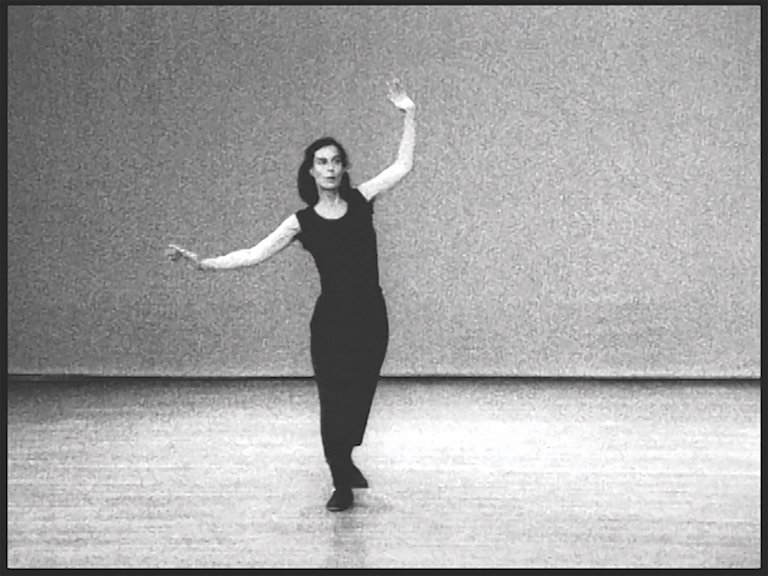
Screenings 16: Yvonne Rainer
Yvonne Rainer (b. 1934) is a dancer and filmmaker whose interdisciplinary practice has achieved legendary status. Starting with her early performances at the Judson Memorial Church in New York City, Rainer challenged reigning ideas about what dance should look like, incorporating everyday actions and non-traditional performers into her highly intellectual choreography. Trio A is one of her most celebrated works. Conceived in 1965, Trio A was danced in discrete sections, each lasting 4 ½ to 5 minutes, all without musical accompaniment. The idea of a “silent” dance performance was something Rainer had absorbed from her close association with John Cage. Over the years, Trio A has evolved into something like a standard in Rainer’s repertoire. On occasion it is intended to be overtly political, as when it was performed by naked dancers draped in American flags, while at other times it has been staged in stark, minimalist terms. Trio A was filmed by Sally Banes, an important dance critic, in 1978. Banes captured Rainer’s solo performance in black and white, 16mm film at Merce Cunningham’s rehearsal studio. Rainer had been on a five-year hiatus from all performing when this film was made.
February 5 - April 10, 2026: CURATORS: DERRICK R. CARTWRIGHT & BRIAN R. CLACK, UNIVERSITY OF SAN DIEGO
Quiet Vision: Prints by John Cage
John Cage (1912-1992) was one of the most influential thinkers of the twentieth century. His transformative ideas about musical composition are matched by his experimental approach to image creation. Cage was an inspiration to some of the most significant visual artists of his time—Jasper Johns, Robert Rauschenberg, Nam June Paik, to name just a few of his collaborators. Additionally, starting around 1978, he made numerous prints of his own. The etchings that Cage produced, together with a handful of lithographs and serigraphs, hold their own alongside his widely discussed musical contributions and essays. Using chance operations and unconventional materials—smoke, rocks, Plexiglas--Cage developed a repertoire of arresting images that merit attention in the present. Quiet Vision: Prints by John Cage includes a group of important works from Crown Point Press in San Francisco, where the artist made the majority of his etchings, as well as loans from private individuals, together with several works from USD’s own permanent collection.
November 13 - December 12, 2025: CURATORS: DERRICK R. CARTWRIGHT & BRIAN R. CLACK, UNIVERSITY OF SAN DIEGO
Screenings 15: Mike Kelley
The fifteenth iteration of the popular Screenings series feat
September 12 - November 7, 2025: CURATORS: DERRICK R. CARTWRIGHT & BRIAN R. CLACK, UNIVERSITY OF SAN DIEGO
Spectral Presences: Spirit Photography, 1865 to the Present
Photography prides itself on making things visible. Since the technology’s patenting in 1839, many photographers have shown clearly, and artfully, what appears in front of their lens. During the era of daguerreotypes, long exposure times meant that a sitter who moved while their likeness was being captured was often presented with a dissatisfying, blurred portrait. These “mistakes” looked ghostly and led to theoretical arguments about whether photography possessed the capacity to reveal unseen presences—auras or, perhaps, spirits. By the 1860s, savvy camera operators, like William Mumler and Alfred Villeneuve, capitalized on this technical problem and invented ways to further manipulate both their negatives and their audiences. They promoted “spirit photography” as a new genre of quasi-scientific importance, generating fierce debates about the medium. Some gullible observers, including Sir Arthur Conan Doyle, believed that the dead could be rendered in photographs. Loved ones appeared hovering around their living relations in these spectral images which had a long reverberation throughout art history. This exhibition explores the origins of “ghost photography,” tracing its popularity from the era of the carte-de-visite to present-day digital representations. Ghost
January 30 - March 7, 2025 Curators: Derrick R. Cartwright & Brian R. Clack, University of San Diego
Screenings 14: Rivane Neuenschwander and Cao Guimarães
The Brazilian conceptual artist Rivane Neuenschwander is best known for her vivid, participatory installations that have been mounted in major institutions such as the Whitechapel Gallery in London and the Carnegie Museum of Art in Pittsburgh. Neuenschwander also makes suggestive videos, most often in partnership with Cao Guimarães, who is himself a celebrated filmmaker from Belo Horizonte, Brazil. The fourteenth in the ongoing Screenings series of time-based works shown in the Humanities Center space is Quarta-Feira de Cinzas/Epilogue, (2006), a collaboration between Neuenschwander and Cao Guimarães that depicts a colony of ants moving brightly colored bits of paper in a rainforest. As a demonstration of Neuenschwander’s prevailing idea of “ethereal materialism,” Quarta-Feira de Cinzas/Epilogue suggest the lessons to be gained from observing aftermaths in contemporary culture
January 30 - March 7, 2025 Curators: Derrick R. Cartwright & Brian R. Clack, University of San Diego
History Repeating: Ruinous Imagination from Piranesi to the Present
Representations of ruins are a major theme throughout art history. From the Renaissance forward, creative depictions of historic architecture in decay or invented scenes of tragic neglect motivated painters and printmakers alike. In the Romantic era, many artists celebrated the ruin as a subject of sublime reflection and aesthetic veneration. Philosophical debates about the qualities of past human achievement proliferated. Contemporary artists have renewed interest in the ruin as a potent, metaphorical subject. History Repeating presents the work of legendary printmakers, such as Giovanni Battista Piranesi and David Young Cameron, alongside more recent works—by Sandow Birk, J.G. Fox, and others—that suggest the critical state of urban environments. History Repeating is the penultimate project in the ongoing seriesof exhibitions that intersect with the Center’s theme of Landscapes and Human Meaning.
28 October - 13 December 2024 Curators: Derrick R. Cartwright & Brian R. Clack, University of San Diego
Screenings 13: Yang Fudong
Yang Fudong is a leading figure in China’s contemporary art scene. His award-winning, epic films combine lush, black and white photography, elaborate staging, and biting social commentary. Moving Mountains (2016) is a 46-minute retelling of an ancient Chinese fable. In devising the film, Yang draws upon modern ink painting of the Revolutionary period. According to the well-known story, a foolish man sets out to physically move a mountain’s location, prompting criticism and mockery from his contemporaries. The old man’s perseverance and commitment finally inspire others. Moving Mountains dovetails with the Humanities Center’s fall theme and is part of the ongoing series dedicated to Landscapes and Human Meaning. Yang Fudong is the 13th artist to be featured in the gallery’s popular Screenings series.
11 September - 18 October 2024 Curators: Derrick R. Cartwright & Brian R. Clack, University of San Diego
The Mountain Since Hokusai
The mountain, specifically Mount Fuji, represents an essential component of traditional Japanese art. For Katsushika Hokusai, this highly recognizable subject became a cherished reference within his celebrated landscape series, 36 views of Mt. Fuji which the artist worked on for nearly a decade. Hokusai’s bold ukiyo-e imagery—so-called “pictures of the floating world”—inspired countless printmakers to revere and abstract mountainous forms. This small exhibition brings together a select group of works that follow in Hokusai’s large footsteps, tracing artistic pathways from the 19th through the 21st centuries. Many of the works displayed are from University Galleries’ increasingly fine permanent collection—including compelling examples of prints by Frances Gearhart and Julian Opie, in addition to other select loans.
2 April - 3 May 2024 Curators: Derrick R. Cartwright & Brian R. Clack, University of San Diego
Screenings 12: Joan Perlman
Joan Perlman is a multi-disciplinary artist who has exhibited widely and received numerous awards and fellowships for her work inspired by the volcanic landscape of Iceland. Her videos, paintings, and drawings consider the raw, convulsive beauty of this place while drawing attention to the perils of accompanying glacial melt. Perlman’s work both documents and resists the morphing terrains that compel her. Recent videos such as Dispersion(2015), Break (2014) and What Remains (2011), combine spectacular footage of moving ice and water with original soundtracks made in collaboration with a range of composers.
2 February - 22 March 2024 Curators: Derrick R. Cartwright & Brian R. Clack, University of San Diego
After Icebergs: Conceptual Photography and Climate Crisis
Nineteenth-century artists were enamored of polar regions and viewed these extreme locales as unparalleled sources of visual wonder. Freighted with romantic ideas about the sublime and scientific debates about geological time, frozen places factored into the representational interests of many leading American painters, like Frederic Edwin Church, whose classic investigation After Icebergs with a Painter (1856) lends this exhibition a title. As part of the Humanities Center’s multi-year inquiry into Landscapes and Human Meaning, After Icebergs: Conceptual Photography and Climate Crisis looks at the persistence of creative fascination with ice during an era when glacial melt and accompanying species extinction are urgent concerns.
27 October - 11 December 2023 Curators: Derrick R. Cartwright & Brian R. Clack, University of San Diego
Screenings 11: Ori Gersht
The popular Screenings series continued with The Forest (2005), a stunning work of video art that was shot in the deep woods near Kosov, Ukraine. This particular forest was once the site of hidden atrocities against the Jewish population of the region. Gersht’s camera lures the viewer through the lush, seemingly Edenic environment while a succession of trees periodically thunder to the ground nearby, splitting the image and all sense of peace. Gersht was born in Israel, but lives today in London. His photographs and videos, including The Forest, have been shown to great acclaim at museums throughout the world, including the Yale Center for British Art in New Haven, CT, The Bauhaus Museum in Weimar, Germany and the Tel Aviv Museum.
8 September - 20 October 2023 Curators: Derrick R. Cartwright & Brian R. Clack, University of San Diego
Gregory Crewdson: Forest Fables
Five of Gregory Crewdson’s complex, large-scale tableaux animated the Humanities Center. The works all explore the dark side of the American forest and share a narrative resonance with American literature, classic cinema, and painterly traditions. Born in Brooklyn, Crewdson is the director of the photography program at Yale University. His works have been featured in major exhibitions throughout the world and his ambitious, intensive practice is the subject of a 2012 documentary film, Gregory Crewdson: Brief Encounters. This project extended the Center’s multi-year study of Landscapes and Human Meaning into the forest theme.
13 March - 15 May 2023 Curators: Derrick R. Cartwright & Brian R. Clack, University of San Diego
Desert Sublime: Southwestern Landscapes by Emma Stibbon
Emma Stibbon is a British artist whose work considers the complexities of extreme environments. Her despictions of arctic ice and glacial melt have been celebrated in exhibitions throughout Europe. Since 2018, Stibbon has expanded her inquiry of harsh landscapes to include the deserts of the American Southwest. Desert Sublime is the first survey of the artist's work done in California and Arizona.
27 January - 3 March 2023 Curators: Derrick R. Cartwright & Brian R. Clack, University of San Diego
Screenings 10: Shirin Neshat
Shirin Neshat is a multi-disciplinary artists who was born in Qazvin, Iran. After studying art in Los Angeles and attending UC Berkeley, Neshat moved permanently to New York City. Although she did not return to her birthplace in Iran until 1993, Neshat’s influential works consider the multivalent experience of women living under a fundamentalist regime. Roja (2016) is the final work in a trilogy of videos called Dreamers which Neshat began in 2013. Loosely autobiographical, Roja exposes the artist’s desire for reunion with her family in Iran, particularly her mother, even as it embraces Neshat’s fascination with dream states and uncanny narratives.
31 October - 16 December 2022 Curators: Derrick R. Cartwright & Brian R. Clack, University of San Diego
Screenings 9: LaToya Ruby Frazier
The ninth iteration of the Humanities Center Gallery's series of time-based works highlighted LaToya Ruby Frazier's Flint is Family (2016). Focusing on the public health crisis that was first identified in Flint, Michigan in 2014, this work documents local residents’ experience as they battled for safe drinking water in their homes. Throughout her video, Frazier combines black and white photographs of both intimate settings and street activism with poetry by a Flint native, Shea Cobb, and a lush cinematic sensibility to achieve what Frazier calls “a platform to advocate for others, the oppressed, the disenfranchised . . . [seeking to] create visibility through images and [to use] story-telling to expose the violation of their rights.”
06 September - 21 October 2022 Curators: Derrick R. Cartwright & Brian R. Clack, University of San Diego
Some Bodies: Oceanic Imagination in Contemporary Art
Artists and their publics have been fascinated with depictions of large bodies of water for centuries. Contemporary artists have shown their own distinct interest in these ocean environments, from purely formal explorations, to romantic suggestions, to impatiently expressed concerns for the natural environment. This small survey of watery imagery drew upon the growing collections of prints and photographs stewarded by University Galleries and featured memorable examples of recent practices by Sandra Cinto, Hiroshi Sugimoto, Christiane Baumgartner, Emma Stibbon, and Bas Jan Ader.
14 March - 20 May 2022 Curator: Brian R. Clack, University of San Diego
The Gout and the Guillotine: The Satirical Imagination in Britain, 1790-1799
This exhibition, centered principally on the work of James Gillray (1756-1815), explored how the grotesque imagination of 18th century satirists interrogated the apparently distinct realms of physical pain and revolutionary politics. Caricatures of the diametrically opposed political thinkers Edmund Burke and Thomas Paine were presented alongside images of that event about which they most fervently disagreed: the French Revolution and its aftermath. And hovering above it all is Gillray’s horrific representation of the body in pain: “The Gout.”
27 January - 4 March, 2022 Curator: Suzie Smith, University of San Diego
Screenings 8: Lorna Simpson
The eighth iteration of the Humanities Center Gallery's series of time-based works focused on Lorna Simpson’s Corridor (2003). Simpson is a contemporary artist whose practice evolved around the camera, creating engaged juxtapositions through conceptual photography and film. This work positions two narratives in the context of one uninterrupted screen, presenting distinct, yet parallel routines of women living a century apart – one presumably during the Civil War and the other during the 1960s when the Civil Rights movement was a defining feature of the time. Simpson’s two-channel presentation oscillates between convergences of domestic routines and divergences in cultural experiences, disrupting the idea of linear historical progress despite substantial evolution in visual culture.
1 November - 17 December 2021 Curators: Denise Rogers & Derrick Cartwright, University of San Diego
Modern Icons
This exhibition considered the place of photography in recent works by artists such as Rico Gatson, Joe Tilson, Ernst Haas, and John Wilson, amongst others. Recent acquisitions from the University’s collection of prints and photographs demonstrated ways in which images of famous faces from the Civil Rights era have been appropriated and re-deployed in order to create vital, and vibrant, contemporary works.
September 1-October 22, 2021 Curator: Derrick Cartwright, University of San Diego
Screenings 7: Eve Fowler
The seventh iteration of the Humanities Center Gallery's series of time-based works focused on Eve Fowler's with it which it as it if it is to be (2016). Fowler is an LA-based artist known for her visual inspections of language and gender. This work was originally shot in 16mm black and white film, subsequently transferred to video, and pairs images of women artists working with a narration of Gertrude Stein's hypnotic short story "Many Many Women."
Curator: Zoe Morales Martinez, '21, University of San Diego
Art and Identity
What defines who we are? Race? Ethnicity? Gender? Sexuality? Class? Religion? Are these categories fluid or fixed? Singular or plural? These questions animate Art and Identity, an online display of contemporary fine art prints curated by USD student Zoe Morales Martinez (’21). Highlighting works from USD’s growing collection of prints, Art and Identity considers the multiple, intersecting forces that make up who we are, how we are seen, and how we represent ourselves.
19 October 2020 - 28 February 2021 Curator: Derrick Cartwright, University of San Diego
Screenings 6: Wangechi Mutu
The sixth iteration of the Screenings series featured Amazing Grace (2005); a rarely-seen, early video work by Wangechi Mutu that features the artist as she moves from a beach into roiling surf. The soundtrack consists of waves breaking and a voice singing John Newton's “Amazing Grace” in Mutu's native tongue: Kikuyu. The fluid imagery and lilting voice belie the tough implications of her performance as she strategically connects the song to the experience of Black Americans and the Transatlantic slave trade, making explicit the historical disjunctions in commonplace uses of the past.
Guest Curator: Cesar Castañeda
Chicano Park @ 50: Renewal and Self-Determination Through Poster Art
Each year since 1970, Chicano Park Day posters have marked the anniversary of the park’s founding. The posters, like the park’s murals, span a range of themes: immigration, social justice, honoring community leaders, and celebrating Chicano cultural heritage, to name a few. Over the course of Chicano Park’s 50-year history, poster artists have paid homage to the original vision of the muralists while advancing their cause of self-determination through creative self-expression. Chicano Park @ 50 commemorated the graphic art imagined by celebrated artists in alliance with the Chicano Park Steering Committee in order to announce and pay tribute to its annual celebration of the Chicano Park Takeover on April 22nd 1970.
27 January – 20 March 2020 Curator: Derrick R. Cartwright, University of San Diego
Screenings 5: Susan Hiller
This fifth iteration of the Screenings series featured a single-channel video by artist Susan Hiller entitled Lost and Found (2016). To create this work, Hiller gathered recordings of the voices of 23 people—in each case the speaker of an endangered or extinct language—and used an oscilloscope to translate their speech into a vibrating green line. The artist studied linguistics while at Hunter College in New York and this particular video is part of her lifeline engagement with anthropological methods.
28 October – 13 December 2019 Curator: John P. Murphy, University of San Diego
Political Skeletons: The Art and Afterlife of José Guadalupe Posada
Born in Mexico in 1852, José Guadalupe Posada is regarded as the "father of Mexican printmaking," celebrated for his bitingly satirical prints. His eye-catching engravings appeared on broadsides—posters printed on cheap paper for Day of the Dead celebrations—that skewered the ruling class, commented on current events, and drew on Mexico’s history and folklore. Posada became identified with the calavera, the skull or skeleton that mocked earthly vanities. After Posada’s death in 1913, his form of “art for the people” exerted a strong influence on socially-conscious artists in Mexico and abroad. Today, artists and printmakers continue to pay homage to Posada—and especially his calaveras—in combining subversive social commentary with graphic power and invention.
4 September - 17 October 2019 Curator: Derrick R. Cartwright, University of San Diego
Screenings 4: Ja'Tovia Gary
Ja’Tovia Gary is an artist and filmmaker who was born in Dallas, Texas. Her work seeks to “liberate the distorted histories through which Black life is often viewed while fleshing out a nuanced and multivalent Black interiority.” Screenings 4 featured two of Gary’s recent works: An Ecstatic Experience (2015) and Giverny I (Négresse Impériale) (2017). The latter film won several awards when it first screened at the 2018 New Orleans Festival and An Ecstatic Experience is now part of the Whitney Museum of American Art’s permanent collection.
19 March – 17 May 2019 Curator: Derrick R. Cartwright, University of San Diego
Screenings 3: Joan Jonas
In collaboration with the Museum of Contemporary Art San Diego (MCASD), the Humanities Center presented a classic work by Joan Jonas, Double Lunar Dogs (1984). Based on Robert Heinlein’s science fiction story, “Universe,” this video reflects the artist’s interests in fragmented narrative and unique effects of her chosen media. Jonas was a pioneer of video art practice in the 1960s and 70s, and today is considered one of the most influential artists of our time.
28 January – 15 March 2019 Curator: John P. Murphy, University of San Diego
Ruskin at 200
John Ruskin (1819-1900) was the Victorian era’s most prominent art and social critic, a complex thinker and provocateur who remains controversial. In honor of his 200th birthday on February 8, 2019, the Humanities Center staged an exhibition related to Ruskin’s cogent writings on nature, art, and society. Featuring artists Ruskin championed as well as vilified, the exhibition explored the range of his influence on Victorian visual culture, including works by J.M.W. Turner, the Pre-Raphaelite Brotherhood, James McNeill Whistler, and William Morris.
29 October – 14 December 2018 Curators: John P. Murphy and Bethany Martinez, '19, University of San Diego
The Printed Word: Textual Play in Contemporary Art
Since the Gutenberg Bible, words have proliferated alongside images in mass reproductions. Typically, a close correlation between text and image exists in printed works of art. In our contemporary moment, artists frequently incorporate statements that, while indisputably creative, may exclude imagery altogether. This exhibition drew on the strength of USD’s growing print collection to examine recent tendencies that explore the printed word.
5 September – 18 October 2018 Curators: Joan Perlman and Derrick Cartwright, University of San Diego
Screenings 2: Joan Perlman
Los Angeles-based artist Joan Perlman has long been fascinated by the stark visual beauty of Iceland. Although she is perhaps best known for her large-scale, atmospheric landscape paintings that conjure Iceland’s unusual geological character, Perlman’s most recent projects have been in digital media—primarily video and captured sound. These works consider the fragile ecological balance that surrounds Iceland in our era of climate change. Her beautifully composed, quietly absorbing works were shown in succession in the Humanities Center Gallery, the second installment in the new series of multi-media displays entitled Screenings.
16 April – 18 May 2018 Curators: Perla Meyers, Odesma Dalrymple, Satyan Devadoss, and Daniel Lopez-Perez, University of San Diego
Folding Borders, Making Unfoldings
Martin and Erik Demaine, both professors at MIT, are a father-son math-art team. The Demaines work together primarily in paper and glass to create sculptures that help to visualize and understand unsolved problems in science. This exhibition featured examples of the Demaines’ sculptures alongside work created by students at USD, the Escuela Libre de Arquitectura in Tijuana, the Chula Vista Library, Kearny High School, and High Tech Village. Led by teams of USD students, participants at these sites created folded paper sculptures inspired by the work of the Demaines and, in some cases, in collaboration with them.
2 March – 6 April 2018 Curator: Katelyn Allen, Class of 2018, Keck Humanities Fellow, University of San Diego
Women Who Impress: Women Printmakers from USD’s Collection
Women Who Impress told the admittedly short story of collecting work by women printmakers for USD’s permanent print collection. While the exhibition intended to celebrate how far we have come in cultivating a strong and diverse collection of works by women printmakers, it also served to inspire new directions for future acquisitions at USD. Transgressing borders and spanning nearly five centuries, the work featured in this show testified to women’s historic engagement with printmaking and spoke collectively to the high levels of ingenuity and printmaking expertise possessed by them.
29 January – 24 February 2018 Curators: Derrick Cartwright and Victoria Fu, University of San Diego
Screenings 1: Victoria Fu, Velvet Peel 1 (2015)
This exhibition inaugurated an experimental series of video works in the Humanities Center Gallery—called Screenings—with the presentation of Victoria Fu’s Velvet Peel 1. In this work, Fu sources imagery from an array of media: desktop screensavers, the internet, original 16mm film, and video from venues where the work has been displayed in the past. Velvet Peel 1 highlights the artist’s concern for how technologies affect our daily lives and explores the tension between screen surfaces and illusory depth.
16 November – 15 December 2017 Curators: Students from Professors Halina Duraj’s and Brad Melekian’s fall 2017 creative and non-fiction writing courses, University of San Diego
Responding to Rouault: USD Student Selections from the Hoehn Gift
Thanks to the generosity of Karen and Robert Hoehn, USD has been home to a complete set of Georges Rouault’s landmark print series, Miserere (1922-27), since 2001. USD writing students were asked to respond to Rouault’s monumental representations about war, grief, and spirit through creative interpretations of his work. These writings were shown in the gallery alongside the prints selected by each student. Their responses reflected the profundity of the images and provided new insights into this much-admired print cycle.
15 September - 20 October 2017 Curator: Derrick Cartwright, University of San Diego
Brazilian Prints: Recent Acquisitions
Brazilian Prints featured a range of concerns expressed by contemporary Brazilian artists: from Claudio Tozzi’s re-imagination of the street protests he witnessed in the 1970s to Juliana Kase’s disassembly of a cellular phone, bold conceptualism unites otherwise distinctive tendencies. All of the works displayed were acquired within the previous three years during a period of extensive research into Brazilian art practices for the exhibition Xerografia: Copyart in Brazil, 1970-1990—a part of the Getty’s Pacific Standard Time: LA/LA initiative. The two projects were mounted and displayed in conjunction with one another.
10 April – 19 May 2017 Curators: Students from the DAA+AH Curator’s Club, University of San Diego
Traffic, 2017
Traffic 2017, a sprawling installation of more than two dozen objects, featured student artists and curators working together to consolidate and display the various strains of artistic production at the university. Curated and organized by students from the Department of Art, Architecture + Art History’s Curator's Club, this exhibition showcased the creative output of then current architecture, visual art, and art history students in conjunction with USD’s annual Creative Collaboration Research Week.
1 February – 3 March 2017 Artists and Organizer: Dan Lopez, Chris Tomlin, and Elizabeth Washburn, Combat Arts San Diego
Full Immersion: An American Patrol Base in Iraq
Full Immersion: An American Patrol Base in Iraq transformed the gallery space into a reproduction of an American patrol base (or P.B.) of the kind widely utilized during the Iraq War. It provided visitors with an immersive experience, suggesting an intimate glimpse into the workings and daily life of a military patrol base. All of the objects, sounds, and imagery used in the installation reflected the firsthand experiences of two Marine combat veterans who conceived, developed and constructed the project on site.
21 November – 14 December 2016 Curator: Jillian A. Tullis, University of San Diego
Thoughts in Passing: Drawings by Claudia Biçen
Death may evoke feelings of trepidation and sorrow, yet for centuries it has inspired artists to create images charged with hope and comfort. Claudia Biçen, a British-American artist who lives in California, uses portraiture as a catalyst for communicating complex ideas about this experience through her practice of interviewing and drawing patients in hospice care. This exhibition displayed eight highly detailed drawings in pencil, coupled with audio recordings of the voices of the men and women portrayed. This twin realism, graphic witnessing and compassionate listening, makes it hard to gaze on Biçen’s work as a disinterested observer.
14 October – 16 December 2016 Curators: Erin Sullivan Maynes and Derrick Cartwright, University of San Diego
Imprint: Student Acquisitions from USD’s Print Collection
In 2013 and 2015, the Legler Benbough Foundation provided two generous gifts to afford USD students with the ongoing experience of acquiring original artworks for the University’s permanent print collection. All of the acquisitions displayed in this exhibition were proposed by teams of undergraduates as part of their coursework and represented the very first time that these prints were shown together as a group. As such, this project offered insight into student judgments and tastes, and, given time, this campus will be the home to a unique collection of works that reflect the changing priorities and concerns of our students.