
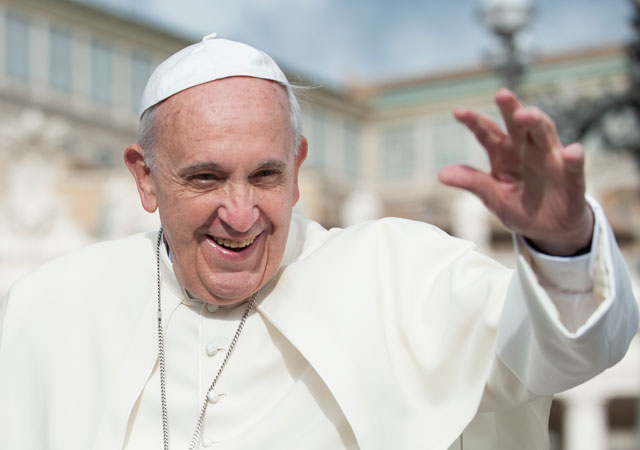
Jorge Mario Bergoglio was born in Buenos Aires December 17, 1936. He earned a chemical technician's diploma from his high school and entered the Jesuit novitiate in March 1958. As part of his Jesuit formation, he taught literature and psychology at Jesuit high schools in the mid-1960s, and he was ordained to the priesthood December 13, 1969.
In 1973, he was appointed superior of the Jesuit province of Argentina. In 1992, Pope John Paul II named him an auxiliary bishop of Buenos Aires. He was promoted to coadjutor archbishop in 1997 and became head of the archdiocese in 1998; St. John Paul named him to the College of Cardinals three years later.
On March 13, 2013, he was elected at the age of 76 to succeed Pope Benedict XVI, the first elected Pope from the Americas. He took the name of Francis.
Early in his pontificate, Pope Francis named an international panel of cardinals — including Cardinal Seán P. O'Malley of Boston — as an advisory panel for church governance. Their first ongoing task is to reorganize the Vatican bureaucracy. The pope has accepted the cardinals' recommendations to establish a council and secretariat for economic affairs, a secretariat for communications and a commission to promote child protection.
Eight months after taking office, Pope Francis published his apostolic exhortation, "The Joy of the Gospel," a detailed vision of the program for his papacy and his vision for the church — particularly the Church's outreach and its response to challenges posed by secular culture. In the document, the pope called on Catholics to go out into the world, sharing their faith "with enthusiasm and vitality" by being living examples of joy, love and charity. "An evangelizer," he said, "must never look like someone who has just come back from a funeral."
Pope Francis' visit to Cuba and the United States in 2015 marked the 10th foreign trip of his pontificate, and it is the first time in his life visiting the United States.
Among Pope Francis’ writings include his 2015 encyclical, Laudato Si, which calls the Church and the world to acknowledge the urgency of our environmental challenges and to join him in embarking on a new path. This encyclical is written with both hope and resolve, looking to our common future with candor and humility. USD is proud to be named a “Laudato Si’ University” by the Vatican with a seven-year commitment to address humanity’s urgent challenges by working together to take care of our common home.
In Fratelli Tutti in 2020, Pope Francis invites the Church to live out the call to universal fraternity and social friendship in “a way of life marked by the flavor of the Gospel" (no. 1) and shares a vision for humanity that Pope Francis has emphasized throughout his papacy: “It is my desire that, in this our time, by acknowledging the dignity of each human person, we can contribute to the rebirth of a universal aspiration to fraternity. Brotherhood between all men and women” (no. 8).
On 21 April 2025 (Easter Monday), Pope Francis died at the age of 88 at Domus Sanctae Marthae in Vatican City. Before his passing, Pope Francis designated the 2025 Holy Year as a time to renew ourselves as "Pilgrims of Hope.” USD was honored to celebrate Pope Francis and his legacy in 2025 with the establishment of the Pope Francis Commons on Human Dignity, reflecting his vision and the university’s efforts to ensure that all members of our community are able to thrive in every dimension of their lives
Sources: United States Conference on Catholic Bishops; Pope Francis Encyclicals; Jubilee 2025