
| Section 80 | |||
| 2/04 - 5/22 | W | 1:30 pm - 3:00 pm | SCST 382 |
| 2/04 - 5/22 | TH | 2:00 pm - 4:00 pm | SCST 382 |
| 2/04 - 5/22 | F | 12:00 pm - 1:30 pm | SCST 382 |
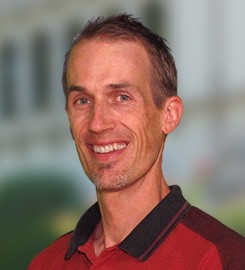
Professor, Chemistry and Biochemistry
- PhD, University of Colorado, Boulder; Analytical and Environmental Chemistry
- BSc, Calvin College, Chemistry
- Postdoctoral studies in Norway and Irvine, CA
David O. De Haan, PhD, came to USD in 2001 from Lyon College. He teaches technology-rich courses in analytical and environmental chemistry. His undergraduate research group is funded by the National Science Foundation (NSF) to study the chemical and optical changes occurring in clouds, aerosol, and smoke plumes as they drift through the atmosphere. As part of this project, USD students are identifying and quantifying chemical aging pathways of wildfire smoke under wet and dry conditions in experiments they conduct at USD and at the CESAM chamber at Université Paris Est - Créteil.
Scholarly Work
De Haan leads a group of undergraduate researchers who explore the aging of smoke plumes using a wide array of chemical and aerosol instrumentation. Group members generate smoke from relevant types of biomass, separate the smoke into gas and aerosol components, and expose these components to different oxidants under either wet or dry conditions to identify the major chemical and optical changes taking place. They examine chemical changes using various mass spectrometry methods, and optical changes using cavity absorption spectrometry. It is our goal to conduct these aging experiments under as close to atmospheric conditions as possible – for example, the chemistry of aerosol aging should be probed by aerosol experiments with realistic surface-to-volume ratios, rather than in bulk liquid extracts.
Since 2001, the project has attracted more than $1.8M in outside funding. 84 USD undergraduate researchers have participated, and co-authored 30 peer-reviewed publications in top journals (see below). Many undergraduates have co-authored multiple articles. More than 30 students have presented their work at national meetings, and many more have presented at Creative Collaborations, USD’s celebration of undergraduate scholarly work.
Areas of Interest
De Haan blends technology and active learning environments into his courses to enhance student involvement. Students in his classes may create blogs to publicly share their research and reactions to course material, make predictions with cell phone response systems, learn Python coding on DataCamp (an intuitive learning platform for data science and analytics), or hone their problem-solving and people skills working face-to-face in groups. His lab courses often include field research on cutting-edge environmental issues, such as the first measurements of perfluorinated compounds in Mission Bay, or the sources of microplastic particles in the human diet. He loves teaching students how to conduct research and believes that undergraduate research can have both personal and scientific impact.
Office Hours
| Section 01 | |||
| 2/04 - 5/22 | W | 1:30 pm - 3:00 pm | SCST 382 |
| 2/04 - 5/22 | TH | 2:00 pm - 4:00 pm | SCST 382 |
| 2/04 - 5/22 | F | 12:00 pm - 1:30 pm | SCST 382 |