
At USD we acknowledge that the land on which we gather is the traditional and unceded territory of the Kumeyaay Nation. We pay respect to the citizens of the Kumeyaay Nation, both past and present, and their continuing relationship to their ancestral lands. The Office of the Tribal Liaison, in collaborations across campus and with community partners, works to build capacity to support Native American students and create relationships with local organizations and tribal communities.
1937-1947
The Early Years
1937
The University of San Diego’s history traces back to Feb. 3, 1937 as Bishop Charles Francis Buddy assumed stewardship of the Catholic Diocese of San Diego. It was a bleak period in U.S. history, as the nation was still mired in the Great Depression. But the energetic bishop was already looking ahead to better times.
In March, Bishop Buddy traveled to San Francisco to speak with Mother Rosalie Clifton Hill from the Society of the Sacred Heart. His hope was to join forces with Mother Hill to establish a Catholic College for Women and a Catholic College for Men in San Diego. Little did they know that World War II was just around the corner. But they were trailblazers and even a war would not alter their path or deter their progress.
1942
On July 17, 1942, a mere seven months after the United States entered World War II, Bishop Buddy wrote a letter to Mother Hill asking, “Would you be interested in inaugurating a Catholic college for women in San Diego? You are my first choice and the one to whom I confide this important work for the glory of God and the salvation of souls.”
Mother Hill replied at once and the two began making plans — she obtained vestments and sacred vessels for the chapel and began purchasing books, noting that “books are always a first need for a college.” Meanwhile, he scoured the city for the perfect piece of land.
1945
In August 1945, one month before the war ended, Mother Hill wrote a letter to the Religious of the Sacred Heart describing that land, known as the Pueblo Lands. “Here in Linda Vista Heights the Bishop purchased a long mountain range, the plateau of which is more than 100 acres,” she wrote. “Now standing on those heights he said to me: ‘Reverend Mother, if you will build here a college and an academy for girls, I will give you fifteen acres of land on any portion of the hill you may desire. The first choice is yours. Will you accept the fifteen acres?’ Before answering, for a moment I prayed. Then, beneath the blue heavens, I said: ‘I will accept in the name of the Society.’”
As plans unfolded, Mother Hill had a special reason for wanting the campus, which would be named Alcalá Park, to be known for its exquisite beauty and intricate design. To this day, USD is recognized as one of the most beautiful campuses in America, earning the nation’s top ranking in 2017 from The Princeton Review.
“There are three things that are significant in education: beauty, goodness and truth,” Mother Hill said in her letter. “But the only one that attracts people on sight is beauty. If beauty attracts people, they will come and find the truth and have goodness communicated to them by the kind of people here.”
The Society of the Sacred Heart concurred with Mother Hill’s sentiments, and promised a $4 million endowment for the College for Women. The original furnishings included ornate crystal chandeliers, beautiful tapestries … and, of course, library books.
During this period, the university received no public funds, relying instead on pledges and gifts made by faithful Catholics throughout the parishes in the San Diego Diocese and beyond.
1947
Bishop Buddy established the University Foundation Fund in November 1947 and sought the help of pastors from parishes in the diocese. When speaking to one pastor he inquired, “How many families have you?” The pastor replied, “Fourteen.” The bishop asked, “Can you raise $1,400?” The pastor’s response was, “We will raise $2,800.”
One of the most touching gifts, according to an account in the Southern Cross newspaper, came from a 5-year-old girl who approached the bishop at a local Christmas party in Old Town. She opened her small palm, sticky with Christmas candy, to make her offering — two bright copper pennies.
The diocese held a month of prayer throughout the Catholic churches and schools for the success of the fund drive. San Bernardino businessman and investor Emmett J. Culligan announced a donation of $50,000 before the end of the month. Bishop Buddy’s effort helped him collect nearly half of his first campaign goal of $2.5 million in less than a year.
1948-1959
The Birth of a Campus
1948
On May 1, 1948, local dignitaries joined Bishop Buddy and Mother Hill for a groundbreaking ceremony atop the wind-swept mesa overlooking the burgeoning San Diego cityscape. “Let the world know that here will be a university where truth will be fearlessly taught,” the bishop declared.
1949
In November 1949, the state of California granted official charters to the San Diego College for Men, the College for Women and the School of Law.
Just weeks later, on the brisk afternoon of Dec. 16, the first bulldozers arrived on the mesa. Under the watchful eye of the founders, the San Diego College for Women complex emerged.
The Founders wing, which was home to Founders Chapel, was completed first. It was followed by its architectural twin, the Camino wing, which featured a theater, now known as Shiley Theatre. Finally, Sacred Heart Hall, which connects the two, was completed.
1952
Classes for the College of Women began in 1952.
1954
In more modest surroundings, the College for Men began classes in 1954, along with the School of Law, which opened across the street in what became University High School and is now an apartment complex — before eventually moving into Thomas More Hall, now known as Warren Hall.
Next came the Administration Building, now known as the Hughes Administration Center, followed by the Immaculate Heart Seminary, now known as Maher Hall.
1959
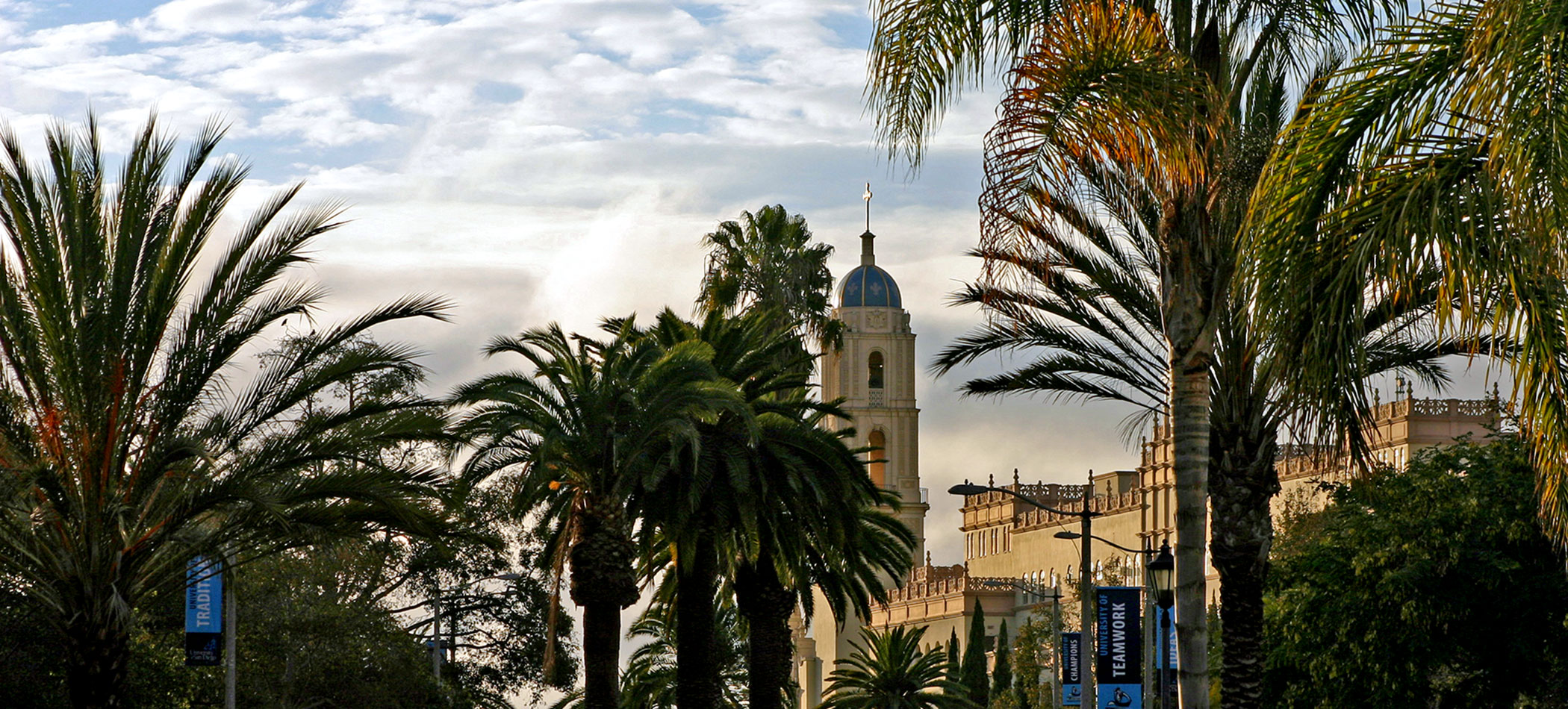
The blue-domed Immaculata Church, the visual centerpiece of the university, was consecrated in 1959. Next came the Knights of Columbus Library, now known as the Pardee Legal Research Center and the Hall of Arts and Science, now known as Saints Tekakwitha and Serra Hall. Finally, came the House of Studies of the Sons of the Sacred Heart, now known as the Degheri Alumni Center, and the USD Student Sports Center and Stadium.
Bishop Buddy and Mother Hill’s vision had become reality. In the decade to come, however, each institution would be shaken by the winds of change. The aftermath altered the direction and identity of the respective institutions.
1960-2015
Modern-Day USD
1967
Talks on academic cooperation between the College for Men and College for Women begin. Women's president and men's president sign a "Reciprocal Course Agreement" allowing students to take classes at either college.
1969
Registrar's offices are combined. Joint admissions policies established. Creation of first all-university academic department, Department of Religious Studies. Students vote to merge student governments. First joint yearbook published.
1971
Author E. Hughes selected as new president of the College for Women and the University of San Diego. All administrative areas, except business affairs, have merged.
1972
The nation was in the midst of the Vietnam War when the San Diego College for Women and the San Diego College for Men and School of Law merged on July 1, 1972, to become the University of San Diego, an independent university governed by its own Board of Trustees.
1978-1992
Under the leadership of Author E. Hughes, who had become president a year before the merger, there was another boom in construction including the School of Nursing’s Muriel Marsh Pavilion in 1978, Guadalupe Hall in 1982, Copley Library in 1984, the Hahn University Center in 1987 and Loma Hall in 1992.
1995-2003
In 1995, Hughes was succeeded by Alice B. Hayes, PhD. Under her tenure that ran until 2003, more square footage was added than in any era since the campus was first built. New signature facilities included the Jenny Craig Pavilion, the Joan B. Kroc Institute for Peace and Justice and the Donald P. Shiley Center for Science and Technology. Construction also began on the Degheri Alumni Center.
During that time, the university’s endowment grew from $40 million to more than $100 million and the university was granted a Phi Beta Kappa charter, the highest academic honor attainable by a liberal arts institution.
USD also expanded its international scope when it signed an agreement to collaborate with a university in Monterrey, Mexico on dual-degree business programs.
The number of professors increased by 20 percent, all employees were outfitted with computers, residence halls went online and all buildings were outfitted with wireless networks.
USD was in the national spotlight as it hosted the final presidential debate between President Bill Clinton and U.S. Sen. Bob Dole in 1996. The men’s basketball team not only hosted, but won the West Coast Conference Championship, earning a berth in the NCAA tournament.
2003-2015
Under the leadership of Mary E. Lyons, PhD, who served as president from 2003 to 2015, the Degheri Alumni Center opened and USD built Mother Rosalie Hill Hall, the Student Life Pavilion and Fowler Park baseball complex.
During that time, USD was the first university on the West Coast to be designated as an Ashoka Changemaker campus. It inaugurated the Joan B. Kroc School of Peace Studies, outfitted 11 buildings on campus with solar panels, opened an Office of Undergraduate Research and established the International Center and was later ranked No. 1 for the percentage of undergraduate students studying abroad.
In addition, USD hosted the Dalai Lama, won the West Coast Conference Commissioner’s Cup for five consecutive years and established the Shiley-Marcos School of Engineering, currently ranked #13th in the nation for undergraduate programs by U.S. News & World Report.
2015
Under James T. Harris III, DEd, who became USD’s fourth president in 2015, the university built the Beyster Institute for Nursing Research and the academic quad known as Paseo de Colachis, an expansive pedestrian promenade, which was made possible due to the success of Leading Change: The Campaign for USD.
2020-Present
Present-Day USD
2020
USD ranks amongst the top universities in the nation in a variety of categories, including: #1 most beautiful campus (Best Choice Schools); #1 for promoting public service (Washington Monthly); #2 for undergraduate study abroad participation (Institute for International Education); and #10 for best quality of life (Princeton Review).
On Dec. 9, NASA named Matthew Dominick ’05 (BS/BA) and Jonathan “Jonny” Kim ’12 (BA) as members of the Artemis Team, a select group of astronauts who will ultimately return to the moon to “learn to live on other worlds for the benefit of all.” The pair are now members of a very exclusive community who will be charting new courses in human history.
2021
USD’s multi-year, comprehensive and strategic initiative for diversity, equity and inclusion, the Horizon Project, was announced by President James T. Harris, DEd. It outlines the immediate, concrete and material steps that the university will take to ensure that inclusive excellence efforts are unequivocally woven into the fabric of the institution.
A celebration was held to mark the completion of the renovation of Camino, Founders and Sacred Heart Halls, marking a major milestone in USD’s 10-year Renaissance Plan. A ribbon cutting and remarks preceded tours for parents, prospective students, faculty and staff. Major changes include dedicated space for theater and visual arts students, a lab for communication studies students, and more.
In September, the university officially opened the doors to the USD Learning Commons, a two-story, 36,000-square-foot learning space adjacent to Copley Library. The state-of-the-art building features nine collaborative study spaces and 13 classrooms, and hosts classes, study groups, work teams and solo exploration. It is also the home to USD’s Honors Program and the USD Writing Center. There is also an impressive “Town Square,” an informal gathering space featuring stadium seating for more than 150 people, encircled by a second-story observation gallery and equipped with the latest in sound and video technology for presentations, films, and other events.
2022
The Knauss School of Business has a new home. The Knauss Center for Business Education officially opened in early August, following a ribbon cutting ceremony that featured USD Board Chairman Don Knauss, the former CEO of Clorox, and his wife, Ellie. In honor of their generosity, the business school was named the Knauss School of Business. Following the cutting of the ceremonial blue ribbon, guests were invited inside for the first time to explore the numerous spaces, which include flexible classrooms, student support services, finance and analytics labs, innovation and entrepreneurship spaces, the Nexus Theater and team collaboration pods.
In mid-December, Women’s Volleyball completed a historic season, recording an all-time program best record of 31-2 overall, and reaching the NCAA Final Four for the first time in team history. Head coach Jennifer Petrie was named the AVCA National Coach of the Year.
2023
Construction begins on USD's Wellness Center and Basketball Practice Center. Slated for completion in 2024, the Wellness Center will be a nexus of health, wellness and community connection. Conveniently located in the heart of campus, the three-story, 80,000 square-foot facility will sit near the main entrance, at the crossroads between the academic area of campus to the west, and the residential and Athletics areas of campus to the east.
2024
USD commemorates its 75th anniversary through a year-long celebration. The anniversary marks the culmination of the “Envisioning 2024” strategic plan and the launch of a new strategic planning initiative.
2025
USD officially opened the Palomar Health Student Wellness Center, launching a campus-wide “Year of Wellness” initiative focused on holistic student health and well-being. In November, the university also announced a historic $75 million gift from the Shiley family to support the development of a new integrated STEM facility, advancing interdisciplinary collaboration across science, engineering and technology programs.